트랜잭션 ACID ①: Atomicity는 어떻게 구현되는가
목차
0. 들어가며
PostgreSQL, MySQL InnoDB, SQL Server 셋 다 WAL 프로토콜을 따르고, 데이터 페이지는 모두 버퍼풀(메모리)에 두며 WAL 로그만 fsync 합니다. 진짜 차이는 이전 버전을 어디에 두느냐, 그리고 그로 인한 롤백 메커니즘의 차이예요.
이 글은 그 정확한 차이를 Atomicity 관점에서 풀어봅니다.
1. Atomicity가 풀어야 하는 진짜 문제
“트랜잭션 내의 모든 쿼리는 전부 성공하거나 전부 실패해야 한다.” 부분 성공은 허용되지 않는다.
말은 단순하지만 구현은 까다롭습니다. 가장 흔한 예시:
BEGIN;UPDATE account SET balance = balance - 100 WHERE id = 1; -- 성공-- 여기서 무슨 일이 생기면?UPDATE account SET balance = balance + 100 WHERE id = 2; -- 실패COMMIT;첫 번째 UPDATE만 반영된 채로 끝나면 100원이 허공으로 사라져요. 일관성 위반의 근본 원인은 원자성 부재입니다. A가 깨지면 C도 즉시 깨져요 — A는 C의 전제 조건처럼 작동합니다.
DB가 보장해야 하는 시나리오는 세 가지예요:
- 트랜잭션 중 한 쿼리가 실패 → 지금까지 성공한 쿼리를 모두 되돌려야 함
- 사용자가 명시적으로 ROLLBACK → 동일
- 트랜잭션 도중에 DB가 다운 → 재시작 시 미커밋 트랜잭션의 흔적을 지워야 함
이 세 시나리오를 어떻게 구현하느냐가 곧 Atomicity 구현 전략이고, 여기서 DB마다 갈립니다.
2. 사전 지식 — STEAL과 NO-FORCE
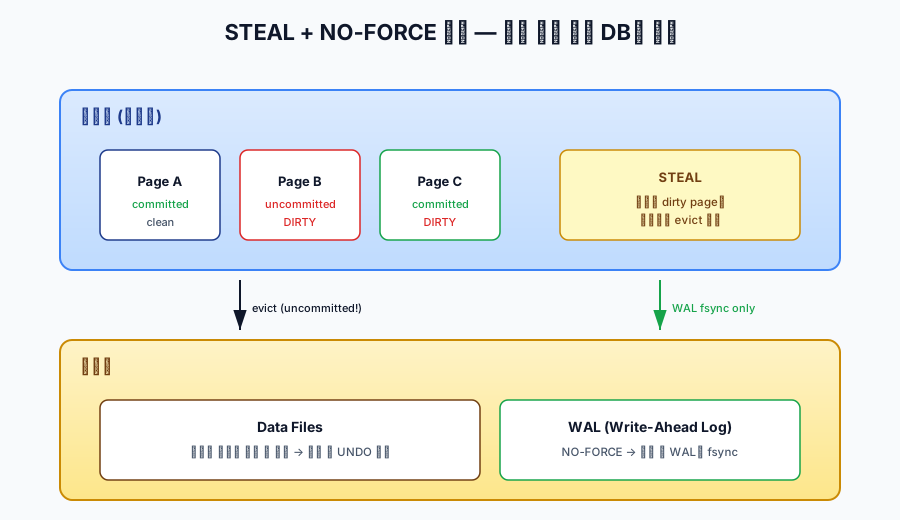
DB 교과서의 표준 용어로 먼저 정리해요. Atomicity 메커니즘을 이해하려면 버퍼 관리 정책 두 가지를 알아야 합니다.
STEAL vs NO-STEAL
미커밋 트랜잭션이 수정한 dirty page를 디스크에 쓸 수 있는가?
- STEAL: 가능. 버퍼풀이 부족하면 미커밋 변경도 디스크로 evict될 수 있음 → 롤백/복구 시 undo가 필요해짐
- NO-STEAL: 불가. 모든 dirty page는 커밋될 때까지 메모리에 묶여야 함 → undo는 필요 없지만, 큰 트랜잭션에서 메모리 압박이 심해짐
FORCE vs NO-FORCE
커밋 시점에 그 트랜잭션의 모든 변경 페이지를 디스크에 강제로 써야 하는가?
- FORCE: 강제. 커밋 시 모든 dirty page를 fsync → redo는 필요 없지만, 커밋이 매우 느려짐
- NO-FORCE: 강제하지 않음. 커밋 시점에는 WAL만 fsync하고, 데이터 페이지는 나중에 천천히 → redo가 필요해짐
거의 모든 현대 DB는 STEAL + NO-FORCE를 씁니다
PostgreSQL, MySQL InnoDB, SQL Server, Oracle 모두 마찬가지예요. 이유는 단순해요 — 성능 때문입니다. STEAL이 없으면 큰 트랜잭션을 못 돌리고, NO-FORCE가 없으면 매 커밋마다 무차별 I/O가 터져요.
대신 그 대가로 redo와 undo 메커니즘이 필요합니다. ARIES 알고리즘이 바로 STEAL + NO-FORCE 환경에서 어떻게 복구할지를 정의한 표준이고, InnoDB와 SQL Server가 이걸 따라요. PostgreSQL은 약간 다른 길을 갔는데, 뒤에서 다룹니다.
3. 롤백을 구현하는 두 가지 철학
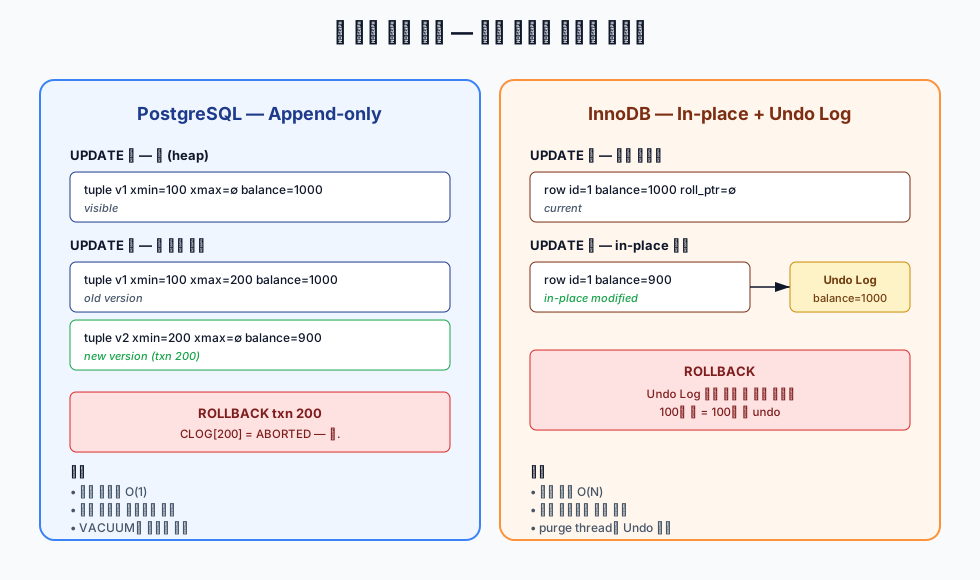
ROLLBACK 명령을 받았을 때 DB가 실제로 무엇을 하느냐? 두 가지 정반대 접근이 존재해요. 차이의 핵심은 이전 버전을 어디에 저장하느냐 입니다.
접근 1: PostgreSQL — Append-only + 가시성 규칙
PostgreSQL은 UPDATE를 받아도 기존 행을 수정하지 않아요. 같은 테이블(힙) 안에 새 튜플을 추가하고 옛 튜플은 그대로 둡니다. 각 튜플은 자신을 만든 트랜잭션 ID(xmin)와 자신을 삭제한 트랜잭션 ID(xmax)를 헤더에 가지고 있어요.
ROLLBACK이 일어나면? 트랜잭션 상태를 CLOG(commit log, 현재는 pg_xact)에 ABORTED로 마킹하면 끝입니다. 그 트랜잭션이 만든 새 튜플들은 자동으로 “xmin이 ABORTED 트랜잭션인 죽은 튜플” 이 되어 가시성 규칙(visibility rules) 에 의해 다른 트랜잭션에게 보이지 않게 돼요.
PostgreSQL 코어 개발자 Tom Lane이 메일링 리스트에서 직접 한 말:
“Commit and abort are both O(1). Where we pay the piper is in having to run VACUUM to clean up no-longer-needed row versions.”
즉 롤백 연산 자체는 O(1) 에 가까워요. 하지만 주의 — 이게 “공짜” 라는 뜻은 아닙니다:
- 트랜잭션이 만든 새 튜플들은 이미 WAL에 기록됐고 디스크 공간도 차지하고 있음
- 그 튜플들을 물리적으로 청소하는 비용은 나중에 VACUUM이 치름
- 인덱스 항목도 같이 누적됨
“롤백 자체는 싸지만, 시스템 전체 비용은 공짜가 아니다.” PostgreSQL은 비용을 지금 즉시 치르는 대신 나중에 백그라운드로 치르는 구조예요.
접근 2: InnoDB / Oracle — In-place 수정 + Undo Log
InnoDB는 정반대예요. UPDATE가 오면 메인 테이블의 행을 in-place로 수정하고, 변경 전 이미지(before-image)를 별도의 Undo Log(rollback segment)에 기록합니다. 행 헤더의 DB_ROLL_PTR이 Undo Log 안의 옛 버전을 가리키는 포인터 역할을 해요.
ROLLBACK이 일어나면? Undo Log를 따라가서 행을 한 줄씩 되돌려야 해요. 100만 행을 수정한 트랜잭션을 롤백하면 100만 번의 undo 작업이 발생합니다. 진짜로 시간이 걸리는 작업이에요.
비용은 어디로 가는가
| 구분 | PostgreSQL | InnoDB / Oracle |
|---|---|---|
| 행 업데이트 | 새 튜플 추가 (append-only) | In-place + 옛 버전을 Undo Log에 |
| 옛 버전의 위치 | 같은 테이블의 힙 | 별도 Undo Log (rollback segment) |
| 가시성 판단 | xmin/xmax + CLOG + 스냅샷 + hint bit | Read view + DB_ROLL_PTR 포인터 체인 |
| 롤백 자체의 비용 | O(1) — abort 마킹만 | O(N) — Undo Log 역재생 |
| 이연 비용 | VACUUM (백그라운드 dead tuple 청소) | Undo tablespace 관리, purge thread |
흔한 오해 정정: “낙관적 vs 비관적” 이라는 표현은 정확하지 않아요. 낙관/비관은 원래 락 전략 용어이고, 여기서의 차이는 MVCC 구현 방식입니다. 면접에서는 “이전 버전을 저장하는 위치가 다릅니다” 라고 말하는 게 안전해요.
4. 크래시가 났을 때의 Atomicity
명시적 ROLLBACK은 그래도 쉬워요. 진짜 까다로운 건 트랜잭션 도중에 DB가 다운되는 경우입니다. 다운된 DB는 스스로 ROLLBACK을 호출할 수도 없어요.
해결책은 재시작 시점의 복구(recovery) 절차입니다. 여기서도 두 학파가 갈립니다.
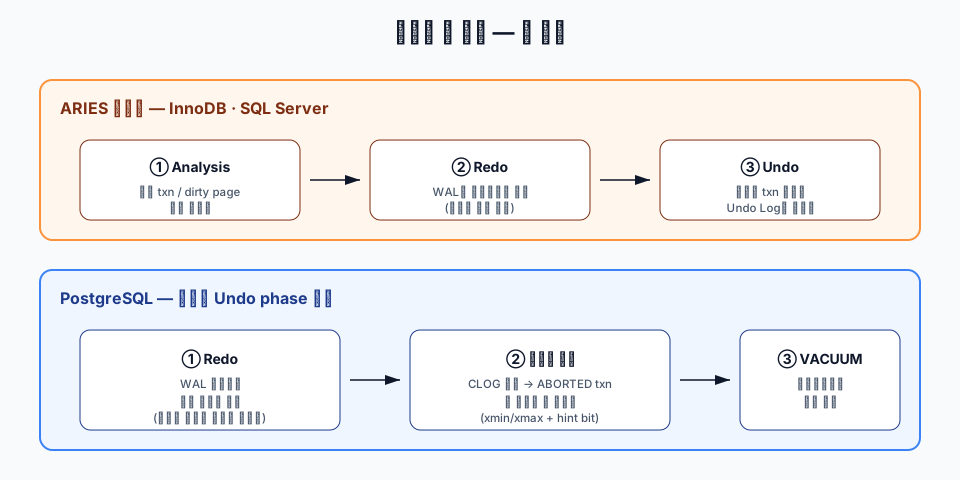
ARIES 스타일 — Redo + Undo (InnoDB, SQL Server)
표준 STEAL + NO-FORCE 환경의 표준 복구 알고리즘이에요. 재시작하면 3단계를 수행합니다:
- Analysis phase — WAL을 읽어서 크래시 시점의 활성 트랜잭션과 dirty page 목록을 재구성
- Redo phase — 마지막 체크포인트 이후의 WAL을 순방향으로 재생해서 모든 변경(미커밋 포함)을 데이터 페이지에 반영
- Undo phase — 미커밋 트랜잭션의 변경을 Undo Log를 따라 역방향으로 되돌림
이 세 단계를 거치면 재시작 후 DB는 “커밋된 트랜잭션의 효과만 남고 미커밋의 흔적은 모두 사라진” 상태가 됩니다.
PostgreSQL 스타일 — 명시적 Undo phase 없이 Redo + 가시성 규칙
PostgreSQL은 다른 길을 택했어요. 재시작 시 명시적인 Undo phase 없이 Redo만 수행하고, 미커밋 트랜잭션의 흔적은 가시성 규칙으로 처리합니다.
PostgreSQL 7.3 공식 문서:
“UNDO operation is not implemented. This means that changes made by aborted transactions will still occupy disk space”
미커밋 트랜잭션의 흔적은 어떻게 사라질까요? 사라지지 않습니다. 디스크에 그대로 남아있어요. 다만 그 튜플들의 xmin이 ABORTED 트랜잭션 ID이기 때문에, CLOG와 가시성 규칙이 그 튜플들을 안 보이게 만듭니다. 사용자 입장에서는 마치 없는 것처럼 보여요.
물리적 청소는 나중에 VACUUM이 해줍니다. hint bit가 한 번 설정되고 나면 CLOG를 매번 조회할 필요도 없어 효율이 더 올라가요.
표현 주의: PostgreSQL이 “undo 개념이 아예 없다” 고 하면 부정확해요. 전통적인 Undo Log 기반 롤백을 사용하지 않을 뿐이고, CLOG와 가시성 규칙(xmin/xmax + hint bit + 스냅샷)으로 동일한 효과를 냅니다. WAL은 이 과정에서 데이터 페이지의 물리적 redo를 담당할 뿐, abort 판정 자체의 메커니즘은 아니라는 점을 구분하세요.
같은 목적, 다른 메커니즘
| 시나리오 | InnoDB / SQL Server | PostgreSQL |
|---|---|---|
| 명시적 ROLLBACK | Undo Log 역재생 | CLOG에 ABORTED 마킹만 |
| 크래시 후 복구 | Analysis → Redo → Undo | Redo + 가시성 규칙 (명시적 Undo phase 없음) |
| 미커밋 변경의 운명 | 물리적으로 되돌려짐 | 가시성 규칙으로 무시됨 → VACUUM이 청소 |
| 핵심 자료구조 | Undo Log, rollback segment | CLOG (pg_xact), hint bit, xmin/xmax |
둘 다 외부에서 보면 동일한 Atomicity 보장을 제공해요. 단지 비용을 언제, 어떤 형태로 치르느냐 가 다를 뿐입니다.
5. WAL은 모두 같은가? — 정확히 짚고 가자
세 DB가 WAL을 쓴다는 점은 같지만, 구현은 동일하지 않아요. 이 부분을 면접에서 “다 같다” 고 하면 깊이 없어 보입니다. 정확하게는:
공통점 (개념 수준)
- 데이터 파일 변경 전에 WAL 레코드를 먼저 기록
- 데이터 페이지는 메모리(버퍼풀)에 있고 WAL만 fsync
- 커밋 보장은 WAL의 fsync로 결정됨
차이점 (구현 수준)
- flush 타이밍: PostgreSQL의
synchronous_commit, InnoDB의innodb_flush_log_at_trx_commit, SQL Server의 delayed durability — 다이얼이 다름 - group commit: 여러 트랜잭션을 묶어 한 번에 fsync하는 전략의 디테일이 다름
- doublewrite buffer: InnoDB는 페이지 부분 쓰기(torn page)를 막기 위한 별도의 doublewrite 영역이 있음. PostgreSQL은
full_page_writes로, SQL Server는 다른 방식으로 같은 문제를 풀어요 - 체크포인트 전략: PostgreSQL의
checkpoint_timeout/max_wal_size, InnoDB의 fuzzy checkpointing, SQL Server의 indirect checkpoint — 모두 다름
WAL의 자세한 동작은 D편(Durability) 에서 다뤄요. 여기서는 “셋 다 WAL을 쓰지만 그 안의 디테일은 다르다” 는 정도로 충분합니다.
6. 그래서 긴 트랜잭션이 어디서든 위험합니다
Atomicity 메커니즘을 이해하면 왜 긴 트랜잭션이 어디서든 안 좋은가가 자연스럽게 보여요. 두 진영 모두 비용을 치르는데, 그 형태만 다릅니다.
PostgreSQL의 부담
- 긴 미커밋 트랜잭션의 스냅샷이 보는 옛 행 버전들을 VACUUM이 청소할 수 없음
- 죽은 튜플이 누적 → 테이블 bloat, 인덱스 bloat, 쿼리 성능 저하
- 오래된 트랜잭션은 트랜잭션 ID wraparound 위험까지 증가시킴
InnoDB의 부담
- 긴 트랜잭션이 살아있는 동안 purge thread가 Undo Log를 정리하지 못함
- History list length(HLL) 가 계속 증가하고 Undo tablespace가 부풀어 오름
- 긴 트랜잭션이 ROLLBACK되면 그동안 쌓인 Undo Log를 모두 역재생해야 해서 진짜로 오래 걸림
공통 부담
- 마지막 체크포인트 이후의 WAL이 길어져서 크래시 복구 시간이 늘어남
- 트랜잭션이 길수록 그 시간 안에 장애가 발생할 확률 자체가 비례해서 커짐
트랜잭션은 짧고 응집력 있게. 비즈니스 로직 단위로 명확하게 끊자. 이 격언의 진짜 근거가 위의 메커니즘들이에요.
7. 정리
Atomicity는 단순한 “전부 성공 or 전부 실패” 규칙이 아니라, “부분 성공의 흔적을 어떻게 지울 것인가” 라는 구현 문제예요. 거의 모든 현대 DB는 성능을 위해 STEAL + NO-FORCE 정책을 쓰고, 그 대가로 redo/undo 메커니즘을 갖춰야 합니다. 이 메커니즘을 두 가지 철학이 다르게 풀어요:
- PostgreSQL — Append-only + 가시성 규칙. 롤백은 abort 마킹만(O(1)), 명시적 Undo phase 없이 Redo + 가시성으로 처리. 비용은 VACUUM으로 이연.
- InnoDB / Oracle — In-place 수정 + 별도 Undo Log. 롤백은 Undo Log 역재생, 크래시 복구는 ARIES 스타일 Redo + Undo.
- SQL Server — InnoDB와 비슷한 ARIES 계열. 단 MVCC는 옵트인(스냅샷 격리)이고 version store는 tempdb에 둠.
세 DB 모두 외부에서 보면 같은 Atomicity 보장을 제공하지만, 내부적으로는 비용을 청구하는 시점과 형태가 완전히 다릅니다.
참고 (1차 자료 우선)
- PostgreSQL Documentation: Write-Ahead Logging (WAL)
- PostgreSQL 7.3 Documentation: WAL — UNDO operation is not implemented
- PostgreSQL Mailing List: PG and undo logging (Tom Lane on commit/abort being O(1))
- PostgreSQL Wiki: Hint Bits
- The Internals of PostgreSQL: Commit Log (clog)
- SQL Server Transaction Log Architecture — Microsoft Learn
- Well-known Databases Use Different Approaches for MVCC — EDB
- Comparing PostgreSQL MVCC vs InnoDB — Severalnines
- InnoDB Undo Log vs Redo Log — Percona
- ARIES: A Transaction Recovery Method (Mohan et al., 1992)
- How Postgres Makes Transactions Atomic — brandur.org

0. Introduction
PostgreSQL, MySQL InnoDB, and SQL Server all follow the WAL protocol. Data pages live in the buffer pool (memory) in all three, and only the WAL log is fsync-ed. The real difference is where the previous version is stored, and the rollback mechanism that flows from that choice.
This post unpacks that real difference from the angle of Atomicity.
1. The Real Problem Atomicity Has to Solve
“Every query inside a transaction must either all succeed or all fail.” Partial success is not allowed.
Simple to state, tricky to implement. Classic example:
BEGIN;UPDATE account SET balance = balance - 100 WHERE id = 1; -- success-- what if something happens here?UPDATE account SET balance = balance + 100 WHERE id = 2; -- failureCOMMIT;If only the first UPDATE lands, 100 vanishes into thin air. The root cause of consistency violation is the absence of atomicity. When A breaks, C breaks immediately — A is essentially a precondition for C.
The DB has to handle three scenarios:
- A query fails mid-transaction → undo all queries that succeeded so far
- The user explicitly issues ROLLBACK → same
- The DB crashes mid-transaction → on restart, erase all traces of uncommitted transactions
How a DB implements these three scenarios is exactly its Atomicity strategy, and this is where DBs diverge.
2. Background — STEAL and NO-FORCE
Let us start with standard textbook terms. To understand the Atomicity mechanism, you need to know two buffer management policies.
STEAL vs NO-STEAL
Can a dirty page modified by an uncommitted transaction be written to disk?
- STEAL: Yes. If the buffer pool is short on memory, even uncommitted changes can be evicted to disk → rollback/recovery now requires undo
- NO-STEAL: No. Every dirty page has to stay pinned in memory until commit → no undo needed, but big transactions create severe memory pressure
FORCE vs NO-FORCE
At commit time, must all modified pages of that transaction be flushed to disk?
- FORCE: Yes. Every dirty page is fsync-ed at commit → no redo needed, but commit becomes very slow
- NO-FORCE: No. Only the WAL is fsync-ed at commit; data pages get flushed lazily later → redo is required
Nearly every modern DB uses STEAL + NO-FORCE
PostgreSQL, MySQL InnoDB, SQL Server, Oracle — all of them. The reason is simple: performance. Without STEAL, you cannot run large transactions; without NO-FORCE, every commit triggers indiscriminate I/O.
The price is needing redo and undo machinery. The ARIES algorithm is the standard for “how do we recover under STEAL + NO-FORCE”, and InnoDB and SQL Server follow it. PostgreSQL took a slightly different path, which we will get to.
3. Two Philosophies for Implementing Rollback
What does the DB actually do when it receives ROLLBACK? Two opposite approaches exist. The crux of the difference is where the previous version lives.
Approach 1: PostgreSQL — Append-only + Visibility Rules
PostgreSQL never modifies an existing row when it receives an UPDATE. It appends a new tuple into the same heap (the table) and leaves the old tuple alone. Each tuple carries in its header the transaction ID that created it (xmin) and the transaction ID that deleted it (xmax).
What happens on ROLLBACK? The DB simply marks the transaction state as ABORTED in the CLOG (commit log, today pg_xact). The new tuples that transaction created automatically become “dead tuples whose xmin is an aborted transaction” and are made invisible to other transactions by the visibility rules.
Tom Lane, a core PostgreSQL developer, said it directly on the mailing list:
“Commit and abort are both O(1). Where we pay the piper is in having to run VACUUM to clean up no-longer-needed row versions.”
So the rollback operation itself is essentially O(1). But careful — that does not mean it is “free”:
- The new tuples that the transaction created have already been written to WAL and are taking up disk space
- The cost of physically cleaning them up is paid later by VACUUM
- Index entries pile up the same way
“The rollback itself is cheap, but the system-wide cost is not free.” PostgreSQL defers the cost — it pays later, in the background, instead of immediately.
Approach 2: InnoDB / Oracle — In-place Modification + Undo Log
InnoDB does the opposite. When an UPDATE arrives, it modifies the row in place in the main table and writes the before-image to a separate Undo Log (rollback segment). The row header’s DB_ROLL_PTR acts as a pointer to the old version inside the Undo Log.
What happens on ROLLBACK? It has to walk the Undo Log and revert each row one by one. Rolling back a transaction that modified a million rows triggers a million undo operations. This is genuinely slow work.
Where the cost goes
| Aspect | PostgreSQL | InnoDB / Oracle |
|---|---|---|
| Row update | Append a new tuple (append-only) | In-place + old version into Undo Log |
| Where the old version lives | The table’s heap | A separate Undo Log (rollback segment) |
| Visibility check | xmin/xmax + CLOG + snapshot + hint bit | Read view + DB_ROLL_PTR pointer chain |
| Rollback cost itself | O(1) — just an abort marker | O(N) — replay the Undo Log |
| Deferred cost | VACUUM (background dead-tuple cleanup) | Undo tablespace management, purge thread |
Common misconception fix: “Optimistic vs pessimistic” is an inaccurate framing. Those terms are about locking strategies; the difference here is the MVCC implementation. In an interview it is safer to say “the place where the previous version is stored is different.”
4. Atomicity Under Crash
An explicit ROLLBACK is the easy case. The truly hard case is the DB crashing mid-transaction. A crashed DB cannot call ROLLBACK on itself.
The solution is a recovery procedure on restart. Two schools of thought again.
ARIES style — Redo + Undo (InnoDB, SQL Server)
The standard recovery algorithm for the standard STEAL + NO-FORCE environment. On restart it runs three phases:
- Analysis phase — read the WAL to reconstruct the active transactions and dirty page list at crash time
- Redo phase — replay the WAL forward from the last checkpoint, applying every change (including uncommitted ones) to the data pages
- Undo phase — undo the changes of uncommitted transactions backward by walking the Undo Log
After these three phases, the DB ends up in a state where “only the effects of committed transactions remain, and no trace of uncommitted ones is left.”
PostgreSQL style — Redo + visibility rules, no explicit Undo phase
PostgreSQL chose differently. On restart it runs only Redo with no explicit Undo phase, and lets the visibility rules take care of uncommitted transactions’ traces.
PostgreSQL 7.3 official docs:
“UNDO operation is not implemented. This means that changes made by aborted transactions will still occupy disk space”
How do the traces of uncommitted transactions disappear? They do not. They stay on disk. But because their xmin is an ABORTED transaction ID, the CLOG and visibility rules make those tuples invisible. From the user’s perspective they look as if they never existed.
Physical cleanup happens later through VACUUM. Once the hint bit is set, you do not even need to consult the CLOG every time, which makes things more efficient.
A note on phrasing: saying “PostgreSQL has no undo concept at all” would be inaccurate. It just does not use traditional Undo-Log-based rollback. The same effect is achieved through CLOG and visibility rules (xmin/xmax + hint bit + snapshot). WAL handles the physical redo of data pages in this story; it is not the mechanism that decides abort itself.
Same goal, different mechanisms
| Scenario | InnoDB / SQL Server | PostgreSQL |
|---|---|---|
| Explicit ROLLBACK | Replay the Undo Log | Just mark CLOG as ABORTED |
| Crash recovery | Analysis → Redo → Undo | Redo + visibility rules (no explicit Undo phase) |
| Fate of uncommitted changes | Physically reverted | Ignored by visibility rules → cleaned by VACUUM |
| Key data structures | Undo Log, rollback segment | CLOG (pg_xact), hint bit, xmin/xmax |
From the outside both deliver the same Atomicity guarantee. They just differ in when and in what form they bill you for the cost.
5. Is WAL the Same Everywhere? — Be Precise
All three DBs use WAL, but the implementations are not identical. Saying “they are all the same” in an interview will sound shallow. Precisely:
What is shared (at the conceptual level)
- WAL records are written before the data files are modified
- Data pages live in memory (buffer pool); only WAL is fsync-ed
- The commit guarantee is decided by WAL fsync
What differs (at the implementation level)
- Flush timing: PostgreSQL’s
synchronous_commit, InnoDB’sinnodb_flush_log_at_trx_commit, SQL Server’s delayed durability — the dials are different - Group commit: the details of bundling many transactions into one fsync differ
- Doublewrite buffer: InnoDB has a dedicated doublewrite area to defend against torn pages. PostgreSQL solves the same problem with
full_page_writes; SQL Server solves it differently - Checkpoint strategy: PostgreSQL’s
checkpoint_timeout/max_wal_size, InnoDB’s fuzzy checkpointing, SQL Server’s indirect checkpoint — all different
The detailed behavior of WAL is for the D (Durability) part. For now, “all three use WAL but the details differ” is enough.
6. Why Long Transactions Are Risky Everywhere
Once you understand the Atomicity mechanism, why long transactions are bad everywhere becomes obvious. Both camps pay a price; only the form differs.
PostgreSQL’s burden
- VACUUM cannot clean the old row versions visible to a long uncommitted transaction’s snapshot
- Dead tuples accumulate → table bloat, index bloat, query slowdown
- Old transactions also raise the risk of transaction ID wraparound
InnoDB’s burden
- While a long transaction is alive, the purge thread cannot trim the Undo Log
- The history list length (HLL) keeps growing and the Undo tablespace bloats
- If a long transaction does ROLLBACK, all the Undo Log accumulated over that time has to be replayed — and that genuinely takes a while
Shared burden
- The WAL since the last checkpoint grows longer, which inflates crash recovery time
- The longer the transaction, the higher the chance of hitting an incident during that time
Keep transactions short and cohesive. Cut them along clear business-logic boundaries. The real basis for that maxim is the mechanisms above.
7. Wrap-up
Atomicity is not just a “all succeed or all fail” rule — it is the implementation question of “how do you erase the traces of partial success?” Nearly every modern DB picks STEAL + NO-FORCE for performance, and pays for it by needing redo/undo machinery. Two philosophies tackle that machinery differently:
- PostgreSQL — Append-only + visibility rules. Rollback is just an abort marker (O(1)); recovery does Redo + visibility, with no explicit Undo phase. Cost is deferred to VACUUM.
- InnoDB / Oracle — In-place modification + a separate Undo Log. Rollback replays the Undo Log; crash recovery is ARIES-style Redo + Undo.
- SQL Server — In the ARIES family like InnoDB. MVCC is opt-in (snapshot isolation) and the version store lives in tempdb.
All three deliver the same external Atomicity guarantee, but internally the moment and form of the bill are completely different.
References (Primary Sources First)
- PostgreSQL Documentation: Write-Ahead Logging (WAL)
- PostgreSQL 7.3 Documentation: WAL — UNDO operation is not implemented
- PostgreSQL Mailing List: PG and undo logging (Tom Lane on commit/abort being O(1))
- PostgreSQL Wiki: Hint Bits
- The Internals of PostgreSQL: Commit Log (clog)
- SQL Server Transaction Log Architecture — Microsoft Learn
- Well-known Databases Use Different Approaches for MVCC — EDB
- Comparing PostgreSQL MVCC vs InnoDB — Severalnines
- InnoDB Undo Log vs Redo Log — Percona
- ARIES: A Transaction Recovery Method (Mohan et al., 1992)
- How Postgres Makes Transactions Atomic — brandur.org
댓글
댓글 수정/삭제는 GitHub Discussions에서 가능합니다.