Presigned URL + EventBridge 기반 파일 업로드 아키텍처
목차
한 줄 요약
서버를 거치는 업로드 방식이 OOM과 이중 전송 문제를 일으킨다는 걸 파악하고, Presigned URL로 S3 직접 업로드 + EventBridge로 완료 감지하는 구조로 전환했습니다.
배경
오락가락은 사용자의 음성을 분석해 음악을 추천하는 서비스입니다.
사용자가 브라우저에서 녹음한 음성 파일을 서버에 올리고, 이걸 WAV로 변환한 뒤 AI 서버가 분석하는 구조입니다.
처음 설계할 때는 “Presigned URL로 S3에 바로 올리면 되겠다”고 생각했습니다.
그런데 AI 분석 담당 팀원이 “추론 서버가 WAV 포맷만 처리할 수 있다”고 했습니다.
브라우저 녹음은 WebM으로 나오니까, 어딘가에서 WAV 변환이 필요했습니다.
그래서 처음엔 파일을 서버로 받아서 변환 후 S3에 저장하는 방식으로 갔습니다.
동작은 했지만, 여기서 문제가 터졌습니다.
서버 업로드 방식의 문제
OOM 위험
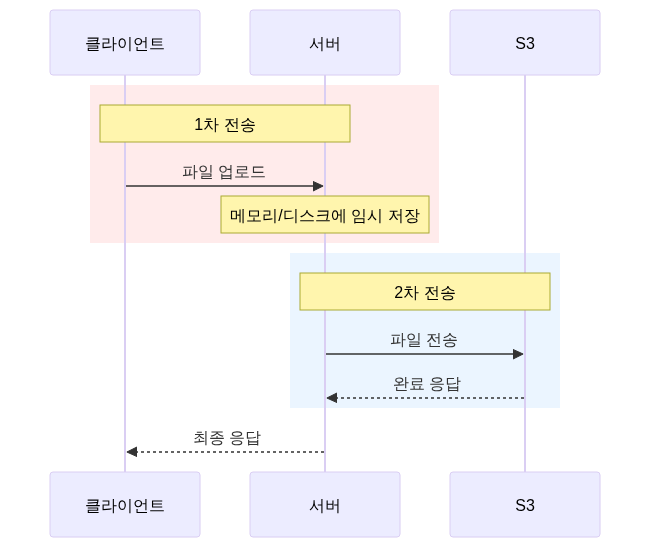
서버 업로드 방식에서는 파일 데이터가 서버 메모리를 경유합니다.
Spring Boot의 StandardMultipartResolver는 file-size-threshold(기본값 0) 이상이면 디스크 임시 파일에 쓰지만, 업로드 수신 중 서블릿 컨테이너가 입력 스트림을 버퍼링하고, 이후 S3로 전송하기 위해 다시 읽는 과정에서 메모리를 사용합니다.
음성 파일 하나가 대략 30-50MB였습니다.
동시 업로드가 10건만 겹쳐도 디스크 I/O + 메모리 버퍼링으로 수백 MB가 순간 점유되고, S3 전송까지 포함하면 요청당 30-40초간 리소스를 점유합니다.
실제로 OOM이 발생한 건 아니지만, 동시 업로드가 증가하면 JVM 힙 압박 → Full GC → 응답 지연 → 스레드 점유 누적으로 이어지는 구조적 위험이 있었습니다.
이중 네트워크 전송
파일이 네트워크를 두 번 탑니다.
클라이언트에서 서버로 한 번, 서버에서 S3로 한 번.
업로드 시간이 두 배고, 서버-S3 구간에서 실패하면 클라이언트부터 다시 보내야 합니다.
서버 상태에 종속
서버가 다운되면 업로드도 불가능합니다.
배포 중에도 업로드가 끊깁니다.
서버를 수평 확장해도 각 서버가 파일을 버퍼링해야 하니, 스케일아웃의 이점이 상쇄됩니다.
WAV 변환을 어디서 할 것인가
Presigned URL을 쓰기로 결정하면, 서버가 파일을 직접 받지 않으니 변환 시점이 달라집니다.
프론트엔드에서 변환할지, 백엔드에서 변환할지 선택해야 했습니다.
프론트엔드 변환의 문제는 용량이었습니다.
WebM은 압축 포맷이라 5MB 정도인데, WAV는 비압축이라 50MB까지 늘어납니다.
모바일에서 50MB 업로드는 사용성이 나빠집니다.
실패 복구도 다릅니다.
프론트에서 변환 중 실패하면 사용자가 다시 녹음해야 합니다.
백엔드에서 변환에 실패하면 S3에 원본이 남아있으니 재시도가 가능합니다.
변환 품질도 백엔드가 유리했습니다.
FFmpeg로 샘플레이트와 비트뎁스를 정밀하게 제어할 수 있습니다.
브라우저의 Web Audio API는 이 부분에서 제약이 있습니다.
원본(WebM)을 S3에 직접 업로드하고, 백엔드에서 FFmpeg로 변환하는 방식을 택했습니다.
최종 아키텍처
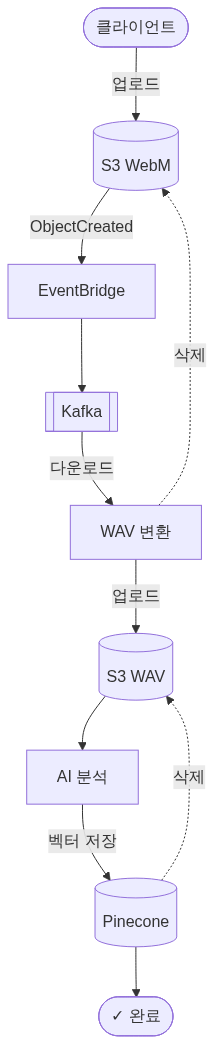
전체 플로우
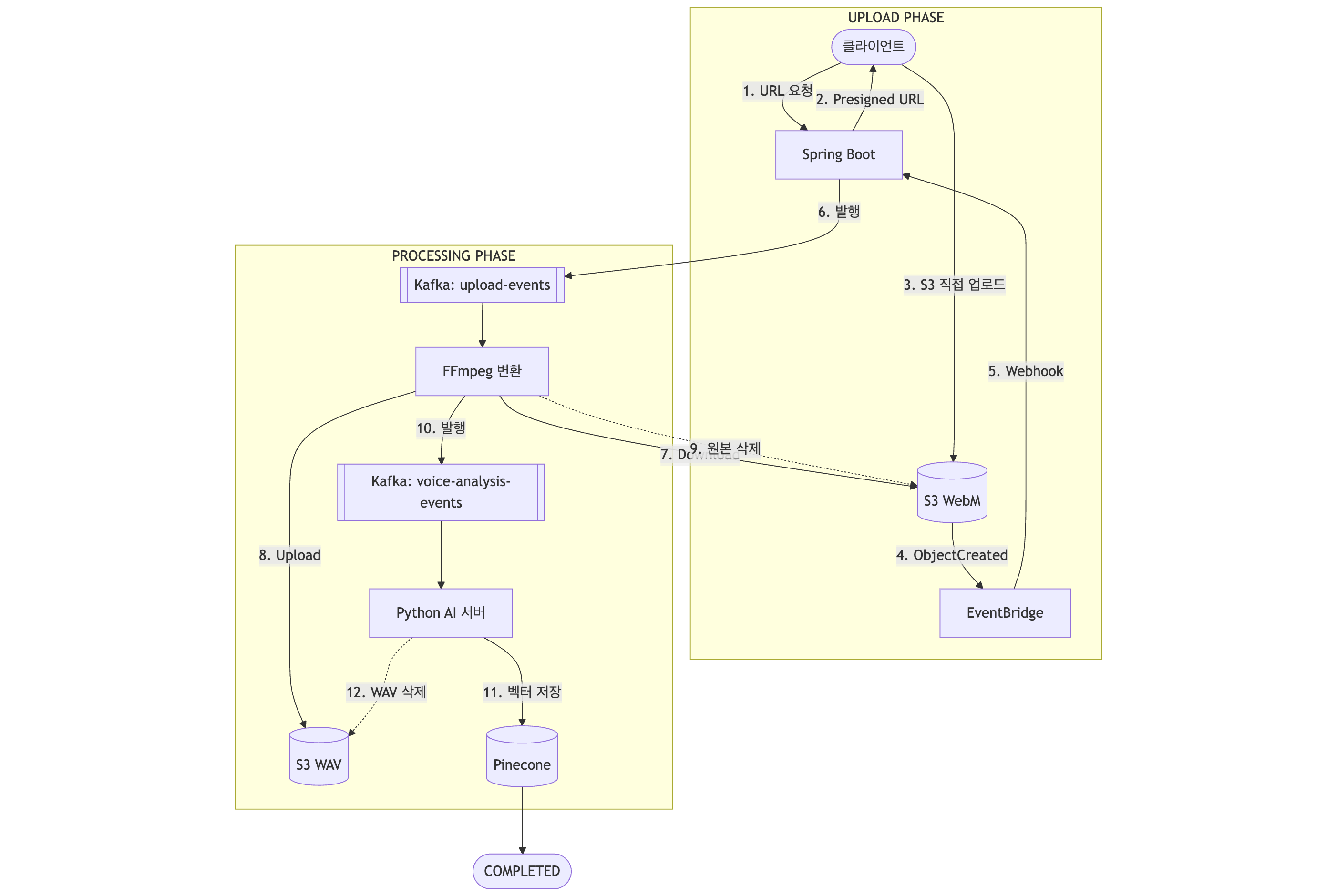
- 클라이언트가 Presigned URL 발급 요청
- 서버가 DB에 Upload 레코드(PENDING) 생성 + S3 Presigned URL 발급
- 클라이언트가 S3에 직접 업로드
- S3 ObjectCreated 이벤트 → EventBridge → Spring Boot 핸들러
- WAV 변환 → AI 분석 → 완료
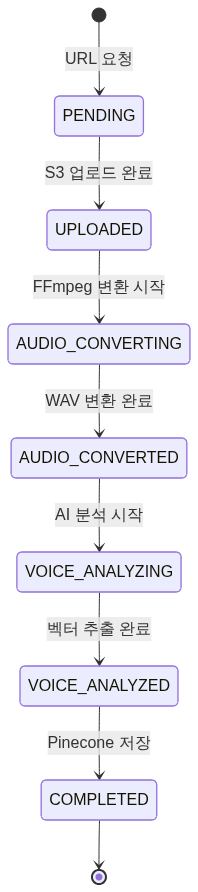
상태 흐름
왜 클라이언트 콜백이 아닌 서버 이벤트인가
처음에는 “S3 업로드 후 클라이언트가 완료 API를 호출하면 되지 않나?”라고 생각했습니다.
세 가지가 문제였습니다.
브라우저를 닫으면 완료 처리가 안 됩니다.
네트워크 오류 시 DB와 S3 상태가 어긋납니다.
업로드 없이 완료 API를 호출하는 악의적 요청도 가능합니다.
S3 이벤트 기반이면 실제로 파일이 올라왔을 때만 트리거됩니다.
서버 상태와 무관하게 동작하고, 신뢰성이 보장됩니다.
왜 S3 Lambda Trigger가 아닌 EventBridge인가
S3 이벤트를 받는 방법은 두 가지가 있습니다.
S3 Event Notification(Lambda)과 EventBridge입니다.
S3 Event Notification은 버킷에 직접 설정합니다.
간단하지만, 같은 prefix에 Lambda 하나만 연결할 수 있습니다.
타겟을 추가하려면 버킷 설정을 고쳐야 합니다.
한 번 실패하면 복구도 어렵습니다.
EventBridge는 S3 버킷 설정과 이벤트 처리 로직이 분리됩니다.
같은 이벤트를 Kafka, Step Functions 등 여러 서비스로 라우팅할 수 있고, 이벤트 아카이브에서 재생도 가능합니다.
새로운 처리 로직을 추가할 때 버킷 설정을 건드릴 필요가 없습니다.
느슨한 결합과 확장성에서 EventBridge가 명확하게 나았습니다.
고아 파일(Orphan Files) 처리
Presigned URL 방식에서 피할 수 없는 문제가 고아 파일입니다.
발생 시나리오는 세 가지입니다.
- Presigned URL을 발급받고 업로드하지 않으면 DB에 PENDING 레코드만 남습니다.
- 업로드는 성공했는데 EventBridge가 실패하면 S3에 파일만 있고 DB는 PENDING입니다.
- WAV 변환 중 서버가 크래시하면 S3에 WebM과 WAV가 둘 다 있을 수 있습니다.
이걸 DB 상태 기반 배치 스캔으로 자동 정리합니다.
| 유형 | 감지 방법 | 처리 |
|---|---|---|
| DB 고아 (PENDING 24시간 이상) | 배치 스캔 | EXPIRED 처리 |
| S3 고아 (FAILED/EXPIRED 14일 이상) | DB 상태 기반 스캔 | S3 파일 + DB 레코드 삭제 |
| 처리 중단 (Stuck 30분 이상) | 배치 스캔 | Kafka 재발행 또는 DLQ |


구현 핵심
Presigned URL 발급

URL 발급 시 DB에 Upload 레코드를 먼저 만듭니다.
S3 이벤트가 올 때 “누구의 어떤 파일인지” 알아야 하기 때문입니다.
S3 키에 UUID를 포함시키고(recordings/{uuid}_{filename}), EventBridge 이벤트에서 UUID를 추출해 레코드를 조회합니다.
S3 이벤트 핸들러

결과
| 지표 | 서버 경유 방식 | Presigned URL 방식 |
|---|---|---|
| 업로드 경로 | 클라이언트 → 서버 → S3 (2홉) | 클라이언트 → S3 (1홉) |
| 서버 메모리 부담 | 파일 크기만큼 점유 | 0 (URL 발급만) |
| 업로드 중 서버 의존 | 서버 다운 시 업로드 불가 | 서버 무관 (S3 직접) |
| 실패 복구 | 클라이언트부터 재전송 | S3에 원본 보존, 백엔드 재시도 |
| 구현 복잡도 | 낮음 | 높음 (EventBridge + 고아 파일 배치 + 상태 머신) |
솔직한 평가
Presigned URL 방식도 완벽하지 않습니다.
업로드 전에 파일을 검증할 수 없다는 게 가장 큰 단점입니다.
서버를 거치면 파일 포맷, 크기, 악성코드 등을 업로드 전에 체크할 수 있지만, S3 직접 업로드에서는 올라온 뒤에야 확인 가능합니다.
Presigned POST 정책(POST Policy)에서 content-length-range 조건으로 파일 크기 상한을, Content-Type 조건으로 허용 포맷을 제한했습니다. (일반 Presigned PUT URL은 파일 크기 제한이 불가능하므로 Presigned POST를 사용했습니다.) 하지만 파일 내용 자체의 검증은 업로드 후에만 가능합니다.
구현 복잡도도 올라갑니다.
Presigned URL 발급, EventBridge 설정, 고아 파일 처리 배치잡까지 관리 포인트가 늘어납니다.
클라이언트에서 S3로 직접 보내니 디버깅도 어렵습니다.
다만 우리 서비스에서는 음성 파일 특성상 업로드 전 검증이 크게 필요 없었고, 서버 메모리 부담 제거가 더 중요했습니다.
그래서 이 트레이드오프를 감수했습니다.
참고 자료
- Spring Boot에서 S3에 파일을 업로드하는 세 가지 방법 - 우아한형제들
- S3 Uploads - Proxies vs Presigned URLs vs Presigned POSTs
- Comparing Two Ways to Trigger Lambda from S3
Summary
Identified OOM risks and double network transfer in server-proxied uploads, then migrated to S3 direct upload via Presigned URL with EventBridge for completion detection.
Background
Orak is a service that analyzes users’ voices to recommend music. Users record voice in the browser, upload it to the server, convert to WAV, then the AI server analyzes it.
Initially planned to use Presigned URLs for direct S3 upload, but the AI team’s inference server only handles WAV format. Browser recordings come as WebM, so WAV conversion was needed somewhere.
The first approach was receiving files on the server, converting, then storing in S3. It worked, but problems emerged.
Problems with Server Upload
OOM Risk
Server uploads route file data through server memory. Spring Boot’s StandardMultipartResolver writes files to disk temp files when exceeding file-size-threshold (default 0), but the servlet container buffers the input stream during upload, and reading it back for S3 transfer consumes memory. Audio files were 30-50MB each, and with 10 concurrent uploads, disk I/O plus memory buffering consumes hundreds of MB while each request holds resources for 30-40 seconds. While OOM didn’t actually occur, the structural risk of heap pressure → Full GC → response delay → thread accumulation was clear.
Double Network Transfer
Files traverse the network twice: client to server, then server to S3. Upload time doubles, and server-to-S3 failures require retransmission from the client.
Server Dependency
Server downtime means no uploads. Deployments interrupt uploads. Horizontal scaling is undermined since each server must buffer files.
Where to Convert WAV
With Presigned URLs, the server doesn’t receive files directly, changing when conversion happens.
Frontend conversion has a size problem: WebM is ~5MB compressed, WAV expands to ~50MB uncompressed. Uploading 50MB on mobile degrades UX. Failure recovery also differs: frontend failure requires re-recording, while backend failure allows retry since the original remains in S3. FFmpeg on the backend also offers precise sample rate and bit depth control.
Decision: upload original WebM directly to S3, convert with FFmpeg on the backend.
Final Architecture
Full Flow
- Client requests Presigned URL
- Server creates Upload record (PENDING) in DB + issues S3 Presigned URL
- Client uploads directly to S3
- S3 ObjectCreated event → EventBridge → Spring Boot handler
- WAV conversion → AI analysis → Complete
State Flow
Why Server Events, Not Client Callbacks
Initially considered having the client call a completion API after S3 upload.
Three problems: closing the browser skips completion processing; network errors desync DB and S3 state; malicious requests can call the completion API without uploading.
S3 event-based triggers only fire when files actually arrive, working independently of server state with guaranteed reliability.
Why EventBridge, Not S3 Lambda Trigger
S3 Event Notification is configured directly on the bucket. Simple, but only one Lambda per prefix. Adding targets requires modifying bucket settings. Recovery from failures is difficult.
EventBridge decouples bucket configuration from event processing logic. The same event can route to Kafka, Step Functions, and more. Event archives enable replay. New processing logic doesn’t require touching bucket settings.
EventBridge was clearly superior for loose coupling and extensibility.
Orphan File Handling
Orphan files are unavoidable with Presigned URLs.
Three scenarios: URL issued but never uploaded (PENDING record remains), upload succeeds but EventBridge fails (file in S3, DB still PENDING), server crashes during WAV conversion (both WebM and WAV in S3).
Automated cleanup via DB-state-based batch scanning:
| Type | Detection | Action |
|---|---|---|
| DB orphan (PENDING > 24hr) | Batch scan | Mark EXPIRED |
| S3 orphan (FAILED/EXPIRED > 14 days) | DB-state scan | Delete S3 file + DB record |
| Stuck processing (> 30min) | Batch scan | Kafka republish or DLQ |
Implementation Details
Presigned URL Issuance
Upload records are created in DB before issuing URLs, so S3 events can identify “whose file.” UUIDs are embedded in S3 keys (recordings/{uuid}_{filename}), extracted from EventBridge events to query records.
S3 Event Handler
Results
| Metric | Server-Proxied Upload | Presigned URL Upload |
|---|---|---|
| Upload path | Client → Server → S3 (2 hops) | Client → S3 (1 hop) |
| Server memory burden | File-size memory occupation | 0 (URL issuance only) |
| Server dependency during upload | Upload fails if server is down | Server-independent (direct S3) |
| Failure recovery | Retransmit from client | Original preserved in S3, backend retry |
| Implementation complexity | Low | High (EventBridge + orphan batch + state machine) |
Honest Assessment
Presigned URLs aren’t perfect. The biggest downside is inability to validate files before upload. Server-proxied uploads can check format, size, and malware beforehand; direct S3 uploads can only verify after arrival. Presigned POST policies enforce content-length-range (file size cap) and Content-Type restrictions — standard Presigned PUT URLs cannot enforce file size limits, so Presigned POST was used. However, content validation is only possible post-upload.
Implementation complexity also increases: Presigned URL issuance, EventBridge configuration, orphan file batch jobs all add management overhead.
However, for our service, audio files didn’t require pre-upload validation, and eliminating server memory burden was more critical. This trade-off was accepted.
References

댓글
댓글 수정/삭제는 GitHub Discussions에서 가능합니다.