Lazy 로딩에서 발생한 No Session 오류
목차
정상 상태
Board(게시글)와 BoardImage(첨부파일)는 @OneToMany 관계로 매핑되어 있습니다.
@OneToMany의 기본 fetch 전략은 FetchType.LAZY로, 게시글을 조회하면 Board 엔티티만 먼저 로딩되고, BoardImage는 실제로 접근하는 시점에 별도 SELECT가 실행되는 구조입니다.
즉, Board 조회 → BoardImage 접근 순서로 총 2번의 SELECT가 실행되어야 정상입니다.
문제 상황
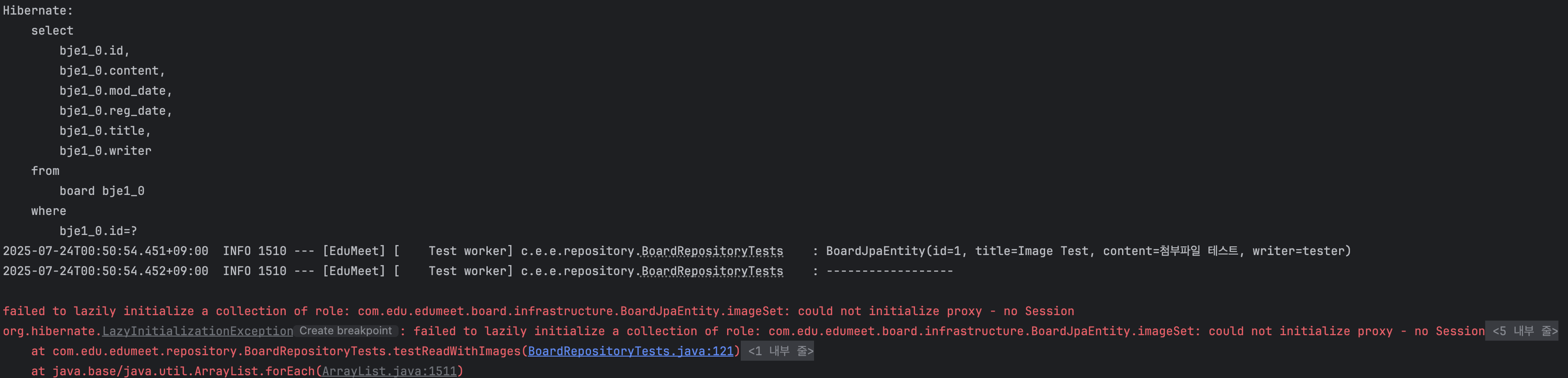
단위 테스트에서 Board를 조회한 뒤 BoardImage에 접근하려 하자, LazyInitializationException: no session 오류가 발생했습니다.
실행 결과를 보면 Board까지의 출력은 정상적으로 끝났지만, 그 직후 BoardImage를 SELECT하려는 시점에 DB 세션이 이미 닫혀 있었습니다.
원인 분석
Lazy 로딩은 영속성 컨텍스트(Persistence Context)가 살아 있는 동안에만 동작합니다.
영속성 컨텍스트는 트랜잭션 범위와 생명주기가 같기 때문에, 트랜잭션이 없는 테스트 메서드에서는 첫 번째 SELECT(Board 조회)가 끝나는 즉시 영속성 컨텍스트가 닫힙니다.
이 상태에서 BoardImage에 접근하면, Hibernate가 프록시 객체를 초기화하려고 하지만 이미 세션이 없으므로 no session 오류가 발생합니다.
핵심은 Lazy 로딩 = 프록시 초기화 = 영속성 컨텍스트 필요라는 점입니다.
테스트 코드에 트랜잭션이 없으면 이 전제가 깨집니다.
해결 과정
1차 시도: @Transactional 추가
가장 단순한 해결책은 테스트 메서드에 @Transactional을 추가하는 것입니다.
이 어노테이션이 적용되면 메서드 전체가 하나의 트랜잭션으로 감싸지므로, 메서드 내에서 추가 쿼리를 여러 번 실행할 수 있습니다.
하지만 이 방법은 테스트 환경에서만 유효한 우회책입니다.
실제 서비스 코드에서는 트랜잭션 범위 밖에서 Lazy 엔티티에 접근하는 상황이 동일하게 발생할 수 있습니다.
2차 시도: @EntityGraph 적용
근본적인 해결을 위해 @EntityGraph를 적용했습니다.
@EntityGraph는 JPA가 제공하는 어노테이션으로, 지정한 연관 엔티티를 조회 시점에 함께 로딩(Eager)하도록 선언할 수 있습니다.

@EntityGraph의 attributePaths에 imageSet을 명시하여, Board 조회 시 BoardImage를 한 번에 가져오도록 설정했습니다.
단위 테스트를 다시 실행한 결과:
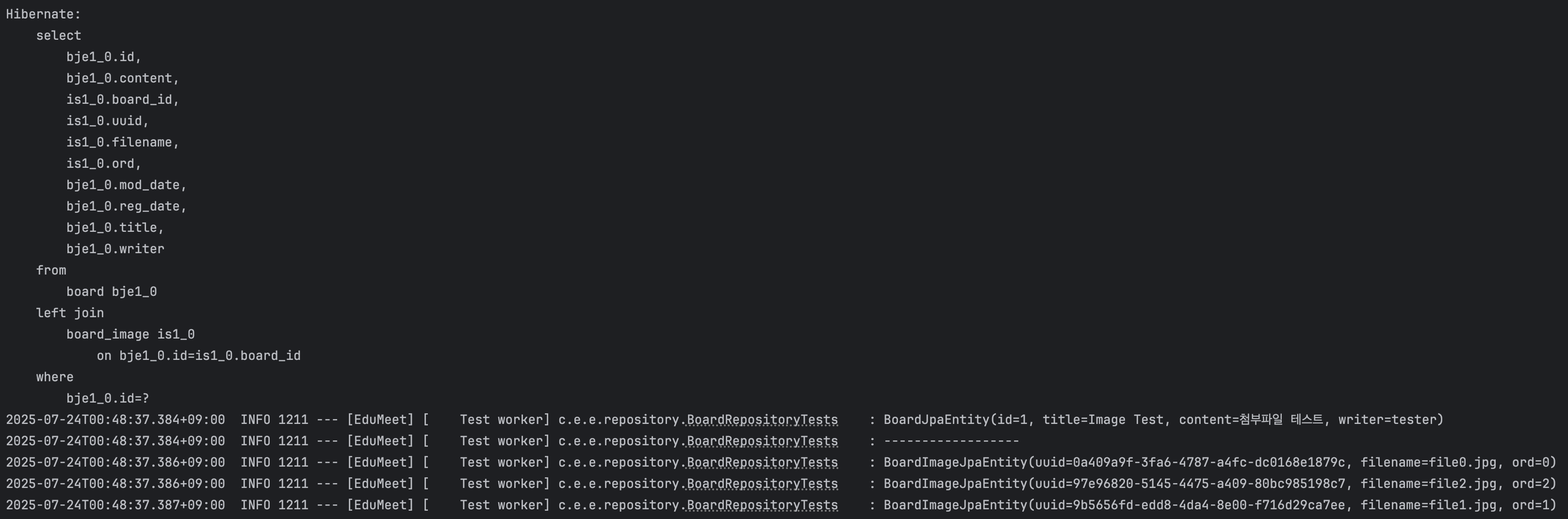
실행 결과의 쿼리를 보면, Board 테이블과 BoardImage 테이블이 LEFT JOIN으로 한 번에 조회됐습니다.
별도의 추가 SELECT 없이 게시글과 첨부파일을 동시에 처리할 수 있게 됐습니다.
정리
| 구분 | @Transactional | @EntityGraph |
|---|---|---|
| 해결 방식 | 트랜잭션 범위 확장 | 조인으로 한 번에 조회 |
| 쿼리 수 | 2회 (Board + BoardImage) | 1회 (JOIN) |
| 적용 범위 | 테스트 한정 우회 | 서비스 코드에서도 적용 가능 |
| 근본 해결 | 아님 | 맞음 |
왜 @Transactional이 아닌 @EntityGraph인가
@Transactional을 테스트에 추가하면 당장은 동작하지만, 두 가지 문제가 있습니다.
- 서비스 코드의 실제 동작을 검증하지 못함: 테스트에서 트랜잭션을 열어주면, 서비스 코드가 트랜잭션 없이도 잘 동작하는 것처럼 보이는 거짓 양성(false positive)이 발생합니다. 실제 운영 환경에서 Controller → Service 호출 시 트랜잭션 범위 밖에서 Lazy 엔티티에 접근하면 동일한
no session에러가 터집니다. - 문제를 숨기는 것이지 해결하는 것이 아님: 테스트가 통과했다고 해서 코드가 안전한 게 아닙니다. Open Session in View(OSIV) 패턴에 의존하는 것과 같은 맥락입니다.
@EntityGraph는 필요한 연관 엔티티를 쿼리 시점에 명시적으로 선언하는 방식이라, 어떤 환경에서든 동일하게 동작합니다. 이 경험 이후 프로젝트 전체에서 Lazy 엔티티에 접근하는 모든 Repository 메서드에 로딩 전략을 명시하는 습관이 생겼습니다.
이 문제에서 배운 원칙
@OneToMany 구조에서 Lazy 로딩을 유지하면서도, 필요한 시점에 @EntityGraph로 Eager 전환을 선언할 수 있다는 점이 핵심입니다. 이후 N+1 문제를 분석할 때도 이 경험이 바탕이 됐습니다. Lazy 로딩의 동작 원리(프록시 초기화 → 영속성 컨텍스트 필요)를 이해하고 있었기 때문에, N+1의 근본 원인을 빠르게 파악할 수 있었습니다.
Reference
- Hibernate ORM 6.0 Migration Guide - DISTINCT
- Vlad Mihalcea - The best way to handle the LazyInitializationException
Normal Behavior
Board (post) and BoardImage (attachment) are mapped with a @OneToMany relationship. The default fetch strategy for @OneToMany is FetchType.LAZY, meaning when a post is retrieved, only the Board entity is loaded first, and BoardImage triggers a separate SELECT when actually accessed.
In other words, Board retrieval → BoardImage access should result in 2 SELECT queries total.
The Problem
In a unit test, after retrieving a Board and trying to access its BoardImage, a LazyInitializationException: no session error occurred.
The execution output showed that Board was printed successfully, but at the point of trying to SELECT BoardImage, the DB session had already closed.
Root Cause Analysis
Lazy loading only works while the Persistence Context is alive. Since the Persistence Context shares its lifecycle with the transaction, in a test method without a transaction, the Persistence Context closes immediately after the first SELECT (Board retrieval).
When BoardImage is accessed in this state, Hibernate tries to initialize the proxy object but fails because the session no longer exists, resulting in the no session error.
The key insight is: Lazy loading = Proxy initialization = Persistence Context required. Without a transaction in test code, this premise breaks.
Resolution
First Attempt: Adding @Transactional
The simplest fix is adding @Transactional to the test method. This wraps the entire method in a single transaction, allowing multiple queries within the method.
However, this approach is only a workaround valid in the test environment. In actual service code, the same situation of accessing Lazy entities outside the transaction scope can occur.
Second Attempt: Applying @EntityGraph
For a fundamental solution, @EntityGraph was applied. @EntityGraph is a JPA annotation that declares specified related entities to be loaded eagerly at query time.
By specifying imageSet in @EntityGraph’s attributePaths, Board retrieval now fetches BoardImage in a single query.
Re-running the unit test:
The query log shows that Board and BoardImage tables were retrieved in a single LEFT JOIN. Posts and attachments can now be processed simultaneously without additional SELECTs.
Summary
| Aspect | @Transactional | @EntityGraph |
|---|---|---|
| Approach | Extend transaction scope | Join in single query |
| Query Count | 2 (Board + BoardImage) | 1 (JOIN) |
| Applicability | Test-only workaround | Applicable in service code too |
| Fundamental Fix | No | Yes |
Why @EntityGraph Over @Transactional
Adding @Transactional to tests works immediately, but has two problems:
- Doesn’t verify actual service behavior: Opening a transaction in tests creates false positives — making service code appear to work without transactions. In production, accessing Lazy entities outside transaction scope (Controller → Service) triggers the same
no sessionerror. - Hides the problem rather than solving it: Passing tests don’t mean safe code. This is the same trap as depending on Open Session in View (OSIV).
@EntityGraph explicitly declares which related entities to load at query time, working identically in any environment. After this experience, I adopted the practice of explicitly specifying loading strategies for all Repository methods that access Lazy entities.
Principle Learned
The key takeaway is that while maintaining Lazy loading in a @OneToMany structure, you can declare Eager fetching with @EntityGraph when needed. This experience became foundational when analyzing the N+1 problem later — understanding Lazy loading mechanics (proxy initialization → Persistence Context required) enabled quick identification of N+1’s root cause.
Reference

댓글
댓글 수정/삭제는 GitHub Discussions에서 가능합니다.