인디밸런싱 - 게임 밸런싱 도구를 직접 만들다
목차
프로젝트 소개
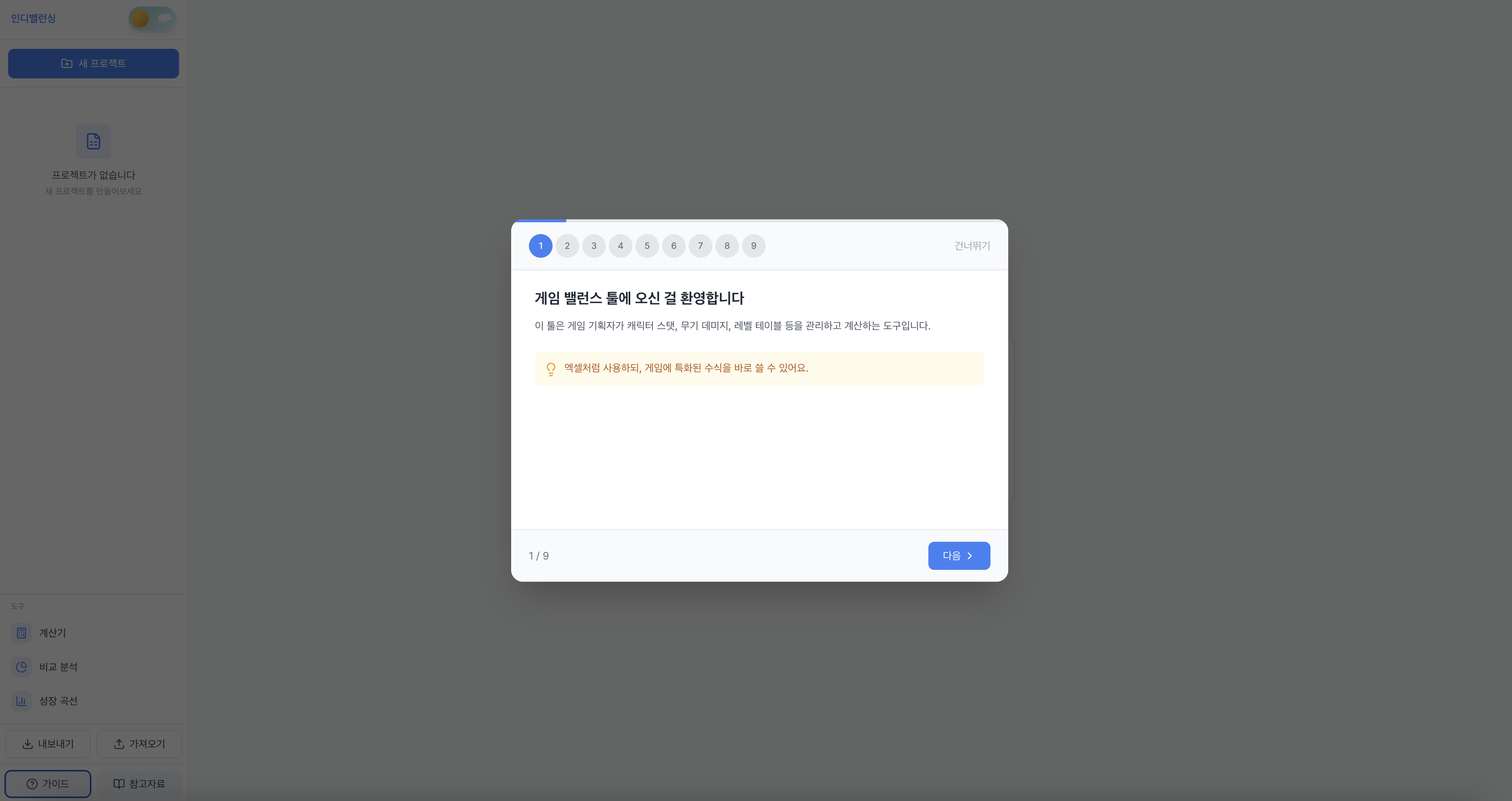
인디밸런싱은 게임 기획자를 위한 오픈소스 밸런싱 플랫폼입니다.
인디게임을 개발할 때 캐릭터 스탯, 무기 수치, 레벨 테이블 같은 밸런스 데이터를 엑셀로 관리하면 여러 불편함이 있습니다. 게임 특화 수식(DAMAGE, TTK, DPS 등)이 없고, 시트 간 연동이 번거롭고, JSON 내보내기도 수동입니다. 이 문제를 해결하는 웹 툴을 만들고 있습니다.
기간: 2025.01 - 진행 중
형태: 개인 프로젝트
기술 스택: React, TypeScript, Zustand, TailwindCSS, Vercel
이론 공부부터 시작
처음에는 “그냥 스프레드시트 만들면 되겠지”라고 생각했습니다. 하지만 어떤 기능이 필요한지, 어떤 수식이 표준인지 전혀 몰랐습니다.
GDC Vault, NDC 2018 밸런스 기획 세션, Zynga 공식 자료를 찾아보면서 게임 밸런싱 이론을 학습했습니다:
- TTK 계산(Time to Kill): 마지막 타격에는 쿨다운을 포함하지 않는다는 것
- Faucet/Sink 모델: Faucet(유입)이 Sink(소모)를 초과하면 인플레이션이 발생하므로, 둘 사이의 균형을 유지해야 한다는 것
- Flow 이론: 난이도가 실력과 적절하게 맞아야 몰입 상태가 유지된다
시장 조사 상세: 게임 밸런스 도구 시장 조사
“만들면서 배우기”도 좋지만, 먼저 이론을 공부하면 시행착오를 줄일 수 있다는 걸 이 과정에서 배웠습니다.
주요 구현
게임 특화 수식
엑셀에는 DAMAGE(atk, def), SCALE(base, level, rate, type), TTK(hp, damage, attackSpeed) 같은 게임 특화 함수가 없습니다. 감소율 공식 DAMAGE, 4가지 성장 곡선(Linear/Exponential/Logarithmic/S-Curve) SCALE, 정확한 킬타임 TTK, 시트 간 참조 REF 등 핵심 함수 23개에서 시작해 현재 70개 이상으로 확장했습니다.
기획자가 =DAMAGE(100, 50)을 입력하면 즉시 66.67을 계산합니다.
밸런스 검증기
유닛 하나씩 수동으로 밸런스를 확인하면 시간도 오래 걸리고 누락이 생깁니다. 기준값(HP, ATK, DEF, 공속) 설정 후 역할별(탱커/딜러/서포터/밸런스) DPS/EHP 허용 범위를 정의하면, 유닛 추가 시 자동으로 범위 이탈 여부를 표시합니다.
기술 포스트: 게임 디자인 도구 소개 · MVP 릴리즈
기억에 남는 트러블슈팅
테이블 드래그 성능
셀이 많아지면 드래그가 버벅거리는 문제가 있었습니다. 가상화와 이벤트 최적화로 해결했습니다.
상세 분석: 테이블 드래그 성능 개선
IME 한글 입력 처리
한글 입력 시 조합 중인 글자가 중복 입력되는 문제가 발생했습니다. compositionstart/compositionend 이벤트로 IME 상태를 추적해서 해결했습니다.
상세 분석: IME 입력 처리
현재 진행 상황과 느낀 점
MVP를 배포한 상태이고, 계속 기능을 추가하고 있습니다. 개인 프로젝트라서 일정 압박은 없지만, 검증된 이론을 기반으로 설계하는 습관은 이 프로젝트를 통해 확실히 갖추게 됐습니다.
팀 프로젝트에서는 경험하기 어려운 처음부터 끝까지 모든 의사결정을 직접 하는 경험이 기획-설계-구현-배포 전 과정에 대한 이해를 넓혀주고 있습니다.
About the Project
IndiBalancing is an open-source balancing platform for game designers.
When developing indie games, managing balance data like character stats, weapon values, and level tables in Excel comes with several pain points. There are no game-specific formulas (DAMAGE, TTK, DPS, etc.), cross-sheet references are cumbersome, and JSON export is manual. I’m building a web tool to solve these problems.
Duration: Jan 2025 – In Progress
Type: Personal Project
Tech Stack: React, TypeScript, Zustand, TailwindCSS, Vercel
Starting with Theory
At first, I thought “I’ll just build a spreadsheet.” But I had no idea what features were needed or which formulas were standard.
I studied game balancing theory from GDC Vault, NDC 2018 balance design sessions, and Zynga official materials:
- TTK Calculation (Time to Kill): The final hit shouldn’t include cooldown
- Faucet/Sink Model: When Faucets (income) exceed Sinks (spending), inflation occurs — so the two must be kept in equilibrium
- Flow Theory: Difficulty must match skill level to maintain a state of flow
Market research details: Game Balance Tool Market Research
“Learning by building” is great, but I learned from this process that studying theory first can reduce trial and error.
Key Implementations
Game-Specific Formulas (70+)
Excel lacks game-specific functions like DAMAGE(atk, def), SCALE(base, level, rate, type), TTK(hp, damage, attackSpeed). Starting with 23 core functions including the diminishing returns formula DAMAGE, 4 growth curves (Linear/Exponential/Logarithmic/S-Curve) SCALE, accurate kill-time TTK, and cross-sheet reference REF, the library has since expanded to over 70 functions.
When a designer enters =DAMAGE(100, 50), it instantly calculates 66.67.
Balance Validator
Manually checking balance for each unit is time-consuming and error-prone. After setting baseline values (HP, ATK, DEF, attack speed) and defining DPS/EHP tolerance ranges by role (Tank/DPS/Support/Balanced), the validator automatically flags units that fall outside their expected range when added.
Technical posts: Game Design Tool Introduction · MVP Release
Memorable Troubleshooting
Table Drag Performance
As the number of cells grew, dragging became sluggish. I resolved it through virtualization and event optimization.
Detailed analysis: Table Drag Performance Improvement
IME Korean Input Handling
During Korean input, characters being composed would get duplicated. I tracked the IME state using compositionstart/compositionend events to resolve the issue.
Detailed analysis: IME Input Handling
Current Progress and Takeaways
The MVP is deployed, and I’m continuing to add features. There’s no schedule pressure since it’s a personal project, but I’ve definitely built the habit of designing based on validated theory through this project.
The experience of making every decision from start to finish on my own — something hard to get in team projects — is broadening my understanding of the entire pipeline from planning to design to implementation to deployment.
댓글
댓글 수정/삭제는 GitHub Discussions에서 가능합니다.