시장조사 후 - 인디게임 밸런스 툴을 만들게 된 과정
목차
1. 문제 인식: 왜 이 프로젝트를 시작했는가
1.1 관찰한 현상
인디게임 개발 커뮤니티를 관찰하면서, 그리고 직접 인디게임을 개발해본 경험에서 반복되는 패턴을 발견했어요.
패턴:
- 개발자가 캐릭터 HP를 1500으로 설정함
- “이게 적정한 수치인가?” 확신이 없어요
- 직접 플레이하며 “감”으로 조정
- 출시 후 유저 피드백: “이 캐릭터 너무 OP임”
- 급하게 핫픽스
왜 이런 일이 발생하는가:
- 대형 스튜디오에는 전담 밸런스 디자이너와 내부 툴이 있어요
- 1~2인 인디 개발자에게는 그런 리소스가 없고요
- 혹은 대형 스튜디오에서는 엑셀/구글 시트를 사용하지만, 게임 특화 기능이 없어서 기획자가 힘들어 하는 경우가 많습니다
1.2 문제 정의
| 문제 | 구체적 상황 | 왜 문제인가 |
|---|---|---|
| 수치의 근거 부재 | HP 1500이 적정한지 모름 | 시간이 지나면 왜 이 숫자로 했는지 까먹음 |
| 검증의 어려움 | 유닛끼리 붙었을 때 밸런스가 맞는지 일일이 테스트 | 조합이 많아지면 수작업 테스트 불가능 |
| 도구의 부재 | 게임 특화 수식, 시뮬레이션, 시각화 도구가 분산됨 | 엑셀, 별도 시뮬레이터, 차트 툴을 따로 써야 함 |
1.3 가설
“DPS/EHP/TTK 같은 게임 공식을 자동 계산하고, 시뮬레이션으로 승률을 검증하고, 이상치를 자동 탐지하는 도구가 있으면 인디 개발자들이 사용할 것이다.”
이 가설을 검증하기 위해 시장조사를 진행했어요.
2. 시장조사: 가설 검증
2.1 조사 방법
- 대상: 인디게임 개발 오픈카톡방 (2,200명 규모, 현업 개발자 다수)
- 방식: 설문조사 + 커뮤니티 반응 수집
- 기간: 약 1주
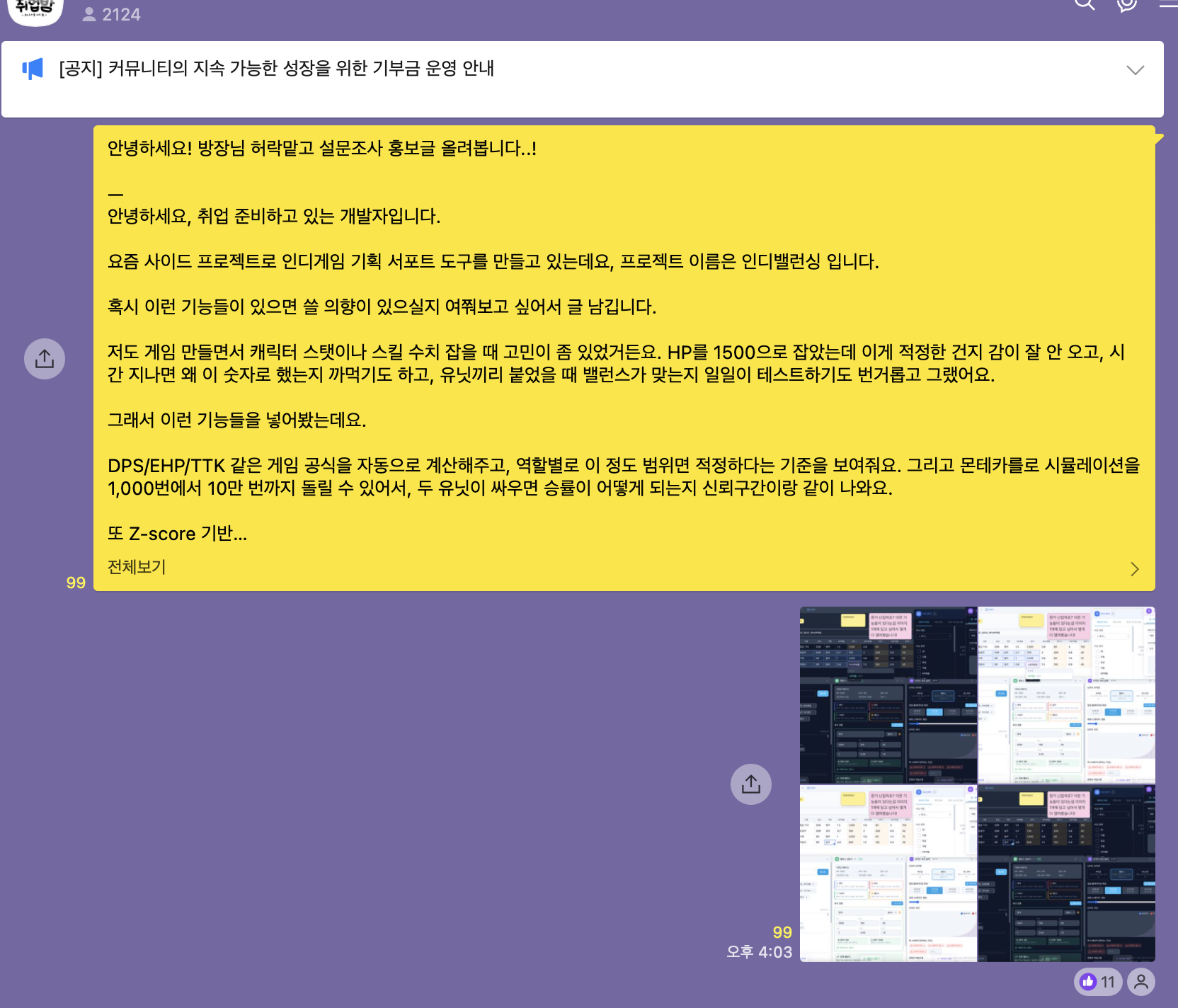
2.2 홍보 문구
안녕하세요, 취업 준비하고 있는 개발자입니다.
요즘 사이드 프로젝트로 인디게임 기획 서포트 도구를 만들고 있는데요,프로젝트 이름은 인디밸런싱 입니다.
저도 게임 만들면서 캐릭터 스탯이나 스킬 수치 잡을 때 고민이 좀 있었거든요.HP를 1500으로 잡았는데 이게 적정한 건지 감이 잘 안 오고,시간 지나면 왜 이 숫자로 했는지 까먹기도 하고,유닛끼리 붙었을 때 밸런스가 맞는지 일일이 테스트하기도 번거롭고 그랬어요.
그래서 이런 기능들을 넣어봤는데요.
- DPS/EHP/TTK 같은 게임 공식을 자동으로 계산- 몬테카를로 시뮬레이션 1,000번~10만 번 → 승률 + 신뢰구간- Z-score 기반 비정상 유닛 자동 탐지- Unity, Godot, Unreal 코드 내보내기
지금 시장조사 중이라 설문 하나 만들었는데요, 3분 정도면 끝나요.
2.3 커뮤니티 즉각 반응
2,200명 규모 방에서의 반응을 정리했어요.
긍정적 반응:
- “흥미롭다”
- “지금 사용할 수 있나요?”
- “언제 써볼 수 있나요?”
- “오 정말 멋진거 만드시네요”
- “일단 다크테마가 있는 시점에서 행복합니다”
기술적 질문:
Q: 전투 연산은 프레임 단위를 돌리나요? 아니면 턴제만 가능한지
A: 현재는 프레임(시간) 기반으로 돌리고 있습니다. 턴제 게임에도 사용 가능하지만 FPS나 MOBA, 액션 RPG 같은 실시간 전투 밸런싱을 생각하면서 만들었습니다.
Q: 난이도 곡선 설계 섹션에서는, 기준에 대한 세부 조정이 사용자 의도대로 수정 가능한건가요?
A: 네 맞습니다. 하지만 아직 초기 단계라 조정 중입니다.
분석: 즉각적인 관심이 있다는 것은 “문제를 겪고 있는 사람들이 존재한다”는 증거예요. 다만 “관심”과 “실제 사용”은 다르므로 설문조사로 더 깊이 파악했어요.
3. 설문조사 결과 분석
2,200명 규모 방에 올렸을 때 12명이 응답했어요. 보상(기프티콘 등) 없이 진행했음에도 12명이 응답한 것은 관심이 있다는 신호로 해석했어요.
3.1 응답자 프로필
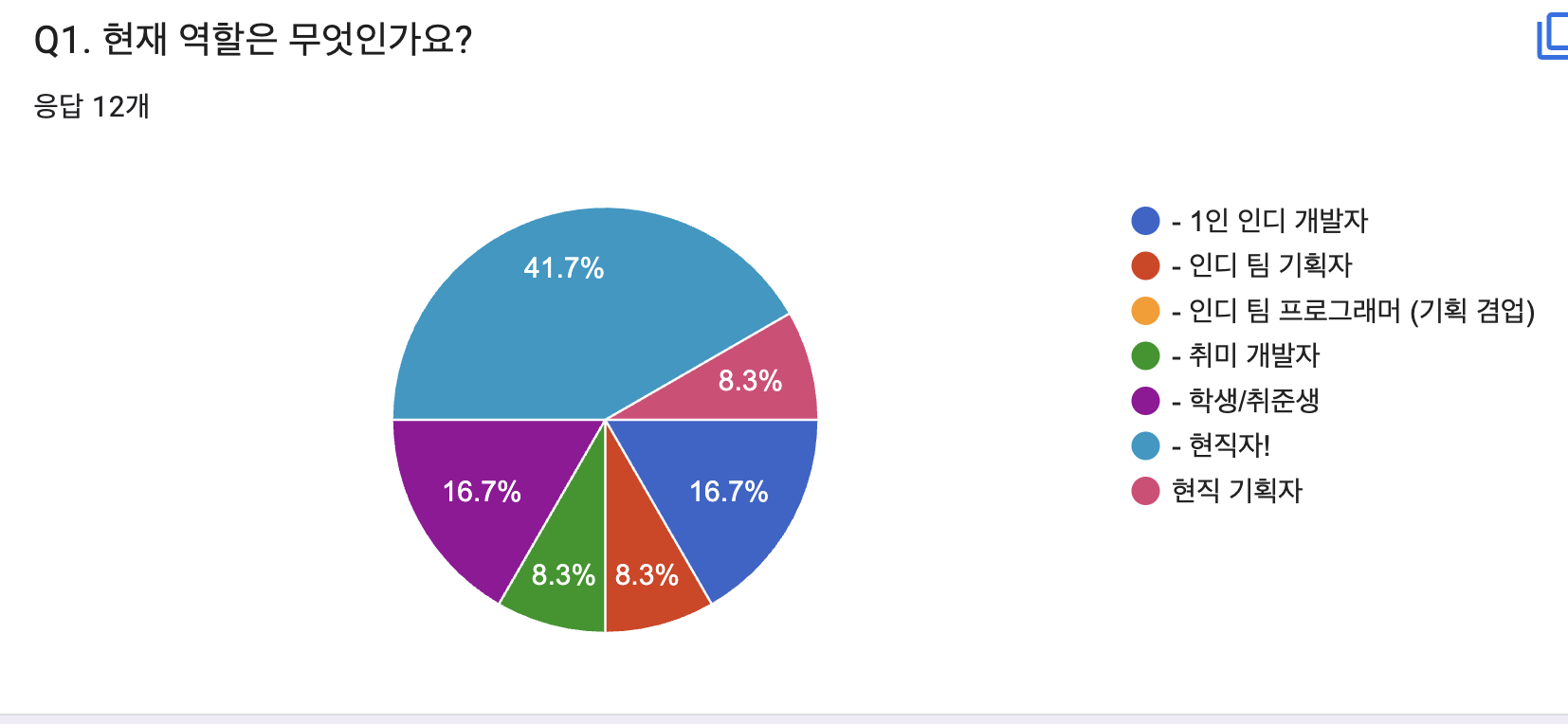
| 역할 | 인원 |
|---|---|
| 현직자 | 6명 |
| 학생/취준생 | 2명 |
| 1인 인디 개발자 | 2명 |
| 취미 개발자 | 1명 |
| 인디 팀 개발자 | 1명 |
분석: 응답자의 절반이 현직자예요. 즉, 실제 업무에서 밸런싱을 하는 사람들이 관심을 가진 거죠.
3.2 개발 중인 장르
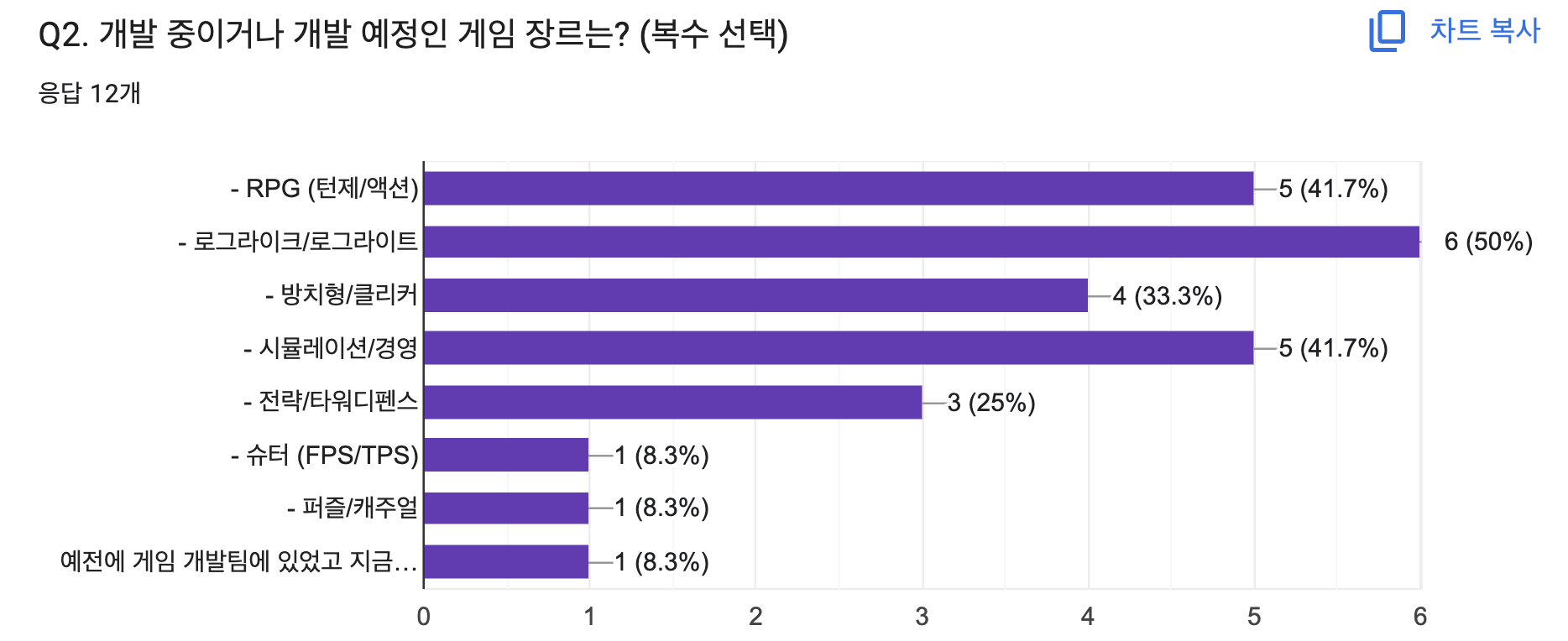
분석: 로그라이크, RPG, 시뮬레이션이 상위권이에요. 이 장르들의 공통점은 “수치 밸런싱이 중요하다”는 거예요. 장르 특성상 타겟 유저가 맞다는 신호예요.
3.3 개발 경험
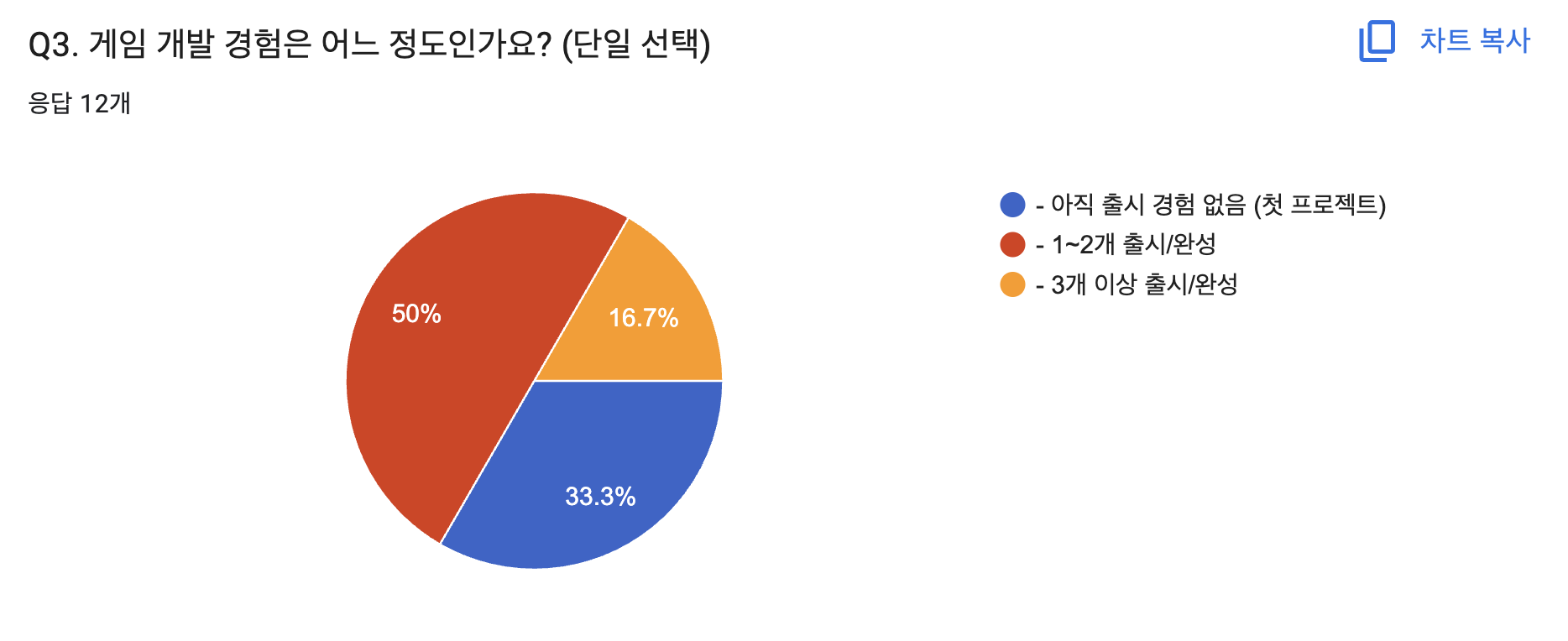
분석: 12명 중 10명이 프로젝트 완성/출시 경험이 있어요. 즉, “실제로 밸런싱 작업을 해본 사람들”이 응답한 거예요. 경험 없는 사람의 의견보다 신뢰도가 높죠.
3.4 현재 사용 도구
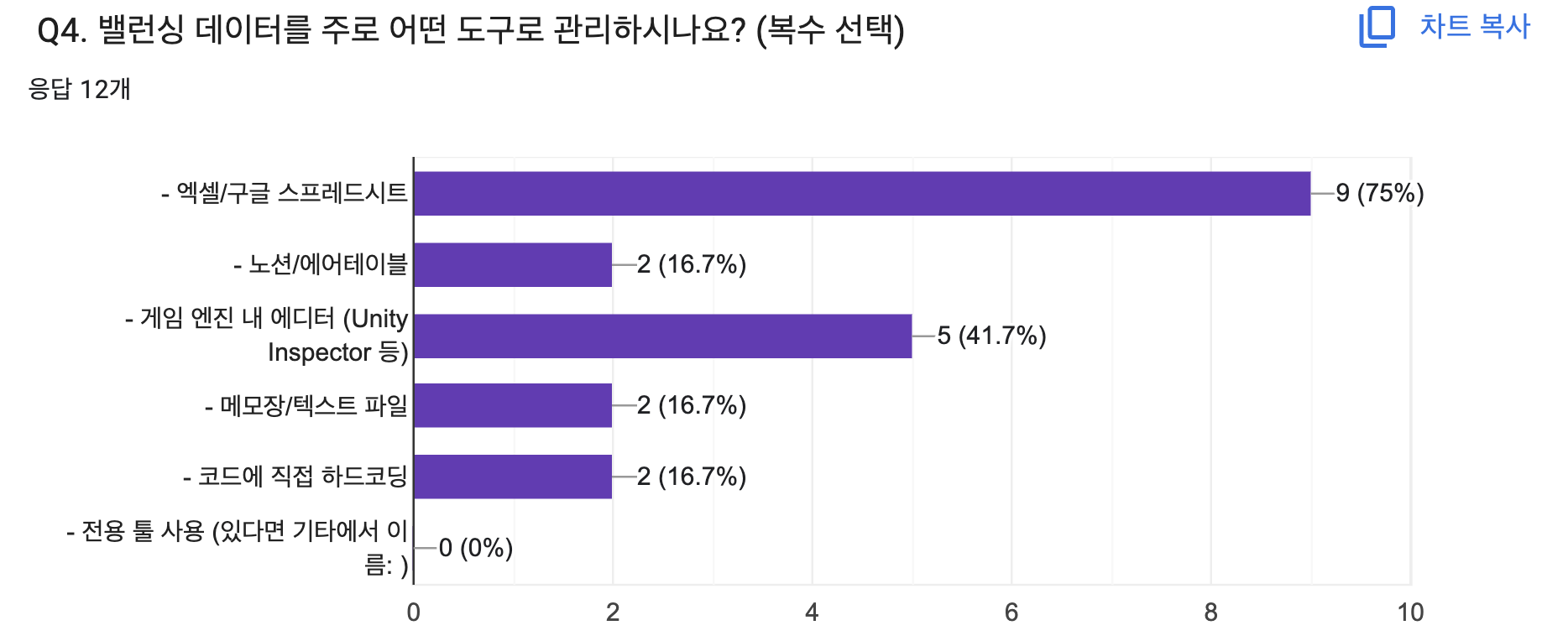
분석: 대다수가 엑셀/구글 시트를 사용해요. 이 도구의 한계를 해결하면 전환할 가능성이 있어요. Unity Inspector를 쓰는 사람도 있는데, 이는 “엔진 내에서 해결하고 싶다”는 니즈를 보여줘요.
별도 의견: “언리얼 테이블은 기획자가 대규모 작업할 때 짜증난다”
→ 기존 도구에 불만이 있다는 증거예요
3.5 현재 방식의 불편한 점
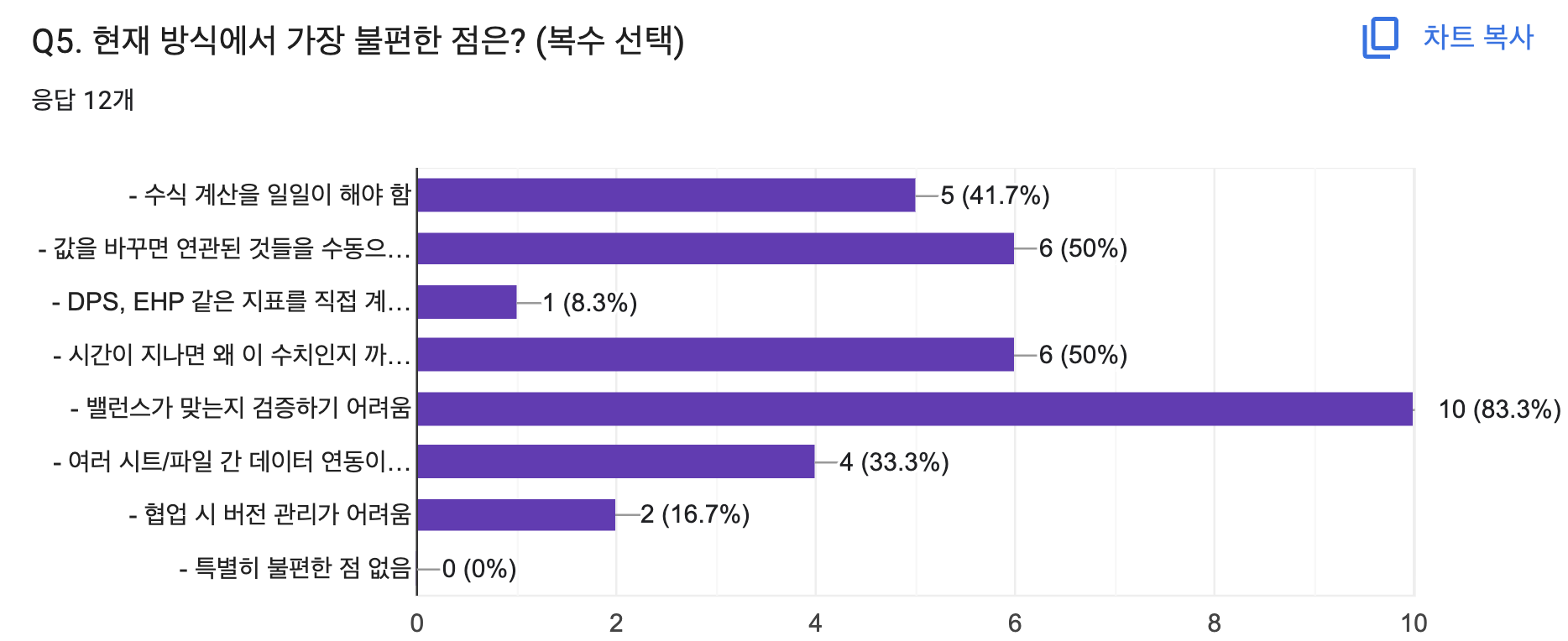
분석: 이 질문의 응답이 핵심이에요. “어떤 불편함을 해결해야 하는가”를 직접적으로 보여주거든요.
3.6 밸런싱 작업에서 어려운 점
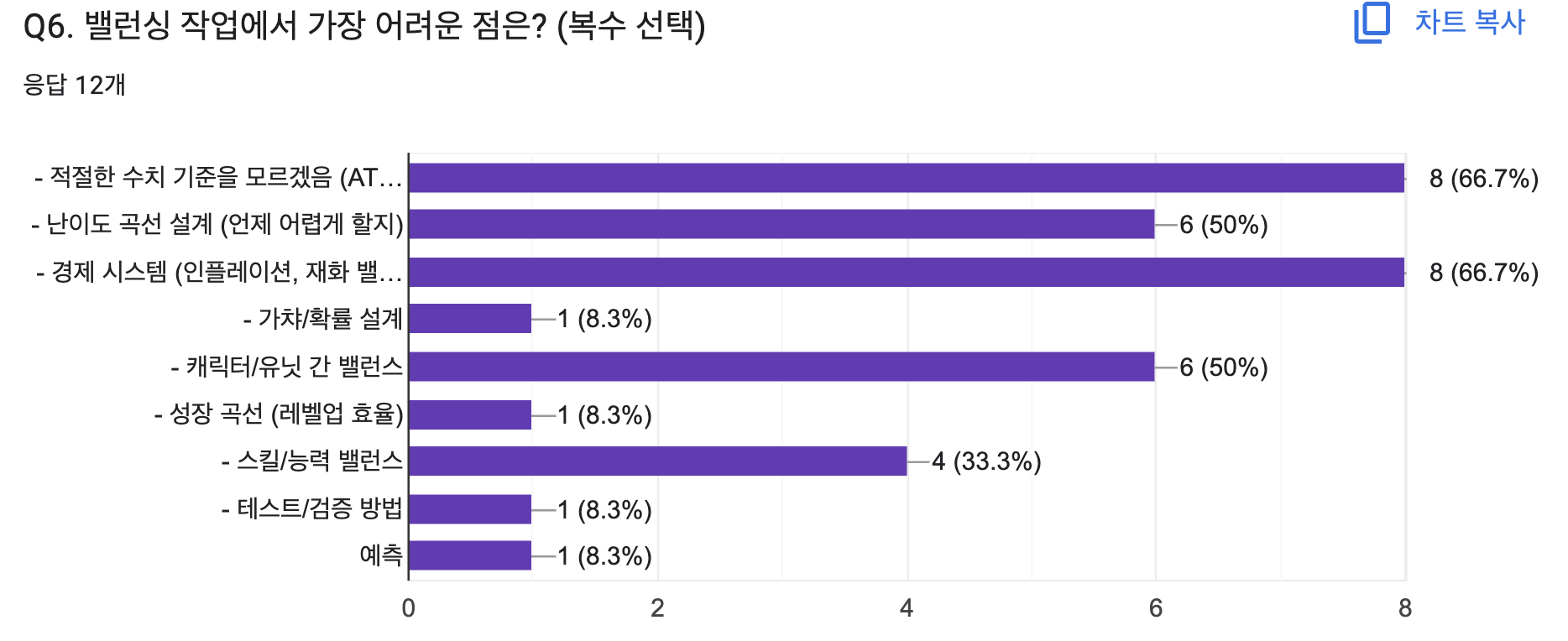
분석: “밸런스가 맞는지 확인하기 어렵다”가 핵심 페인 포인트예요. 이것이 몬테카를로 시뮬레이션 기능의 근거가 돼요.
3.7 정보 습득 경로
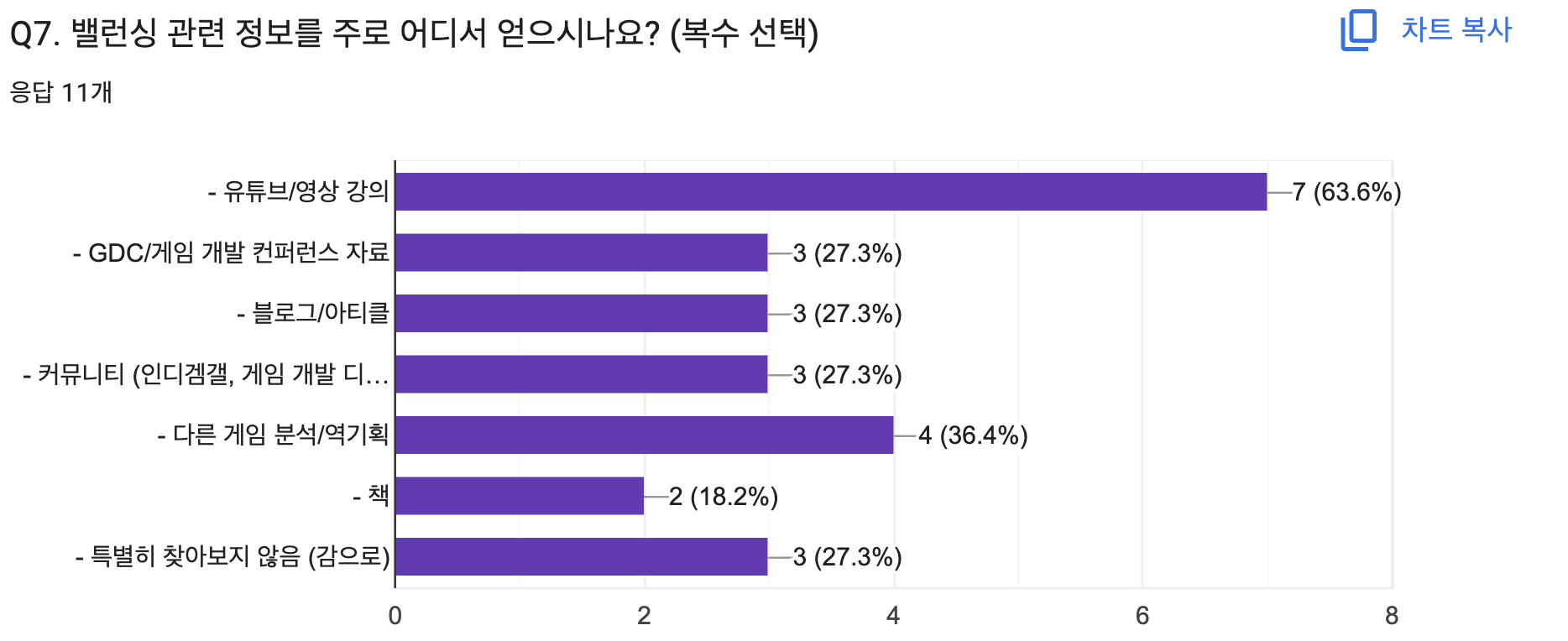
분석: 레퍼런스 게임 분석, 커뮤니티, 유튜브가 상위권이에요. 즉, “체계적인 학습 경로가 없다”는 뜻이죠. 이론적 배경을 제공하면 차별화 포인트가 될 수 있어요.
3.8 원하는 기능 (주관식)
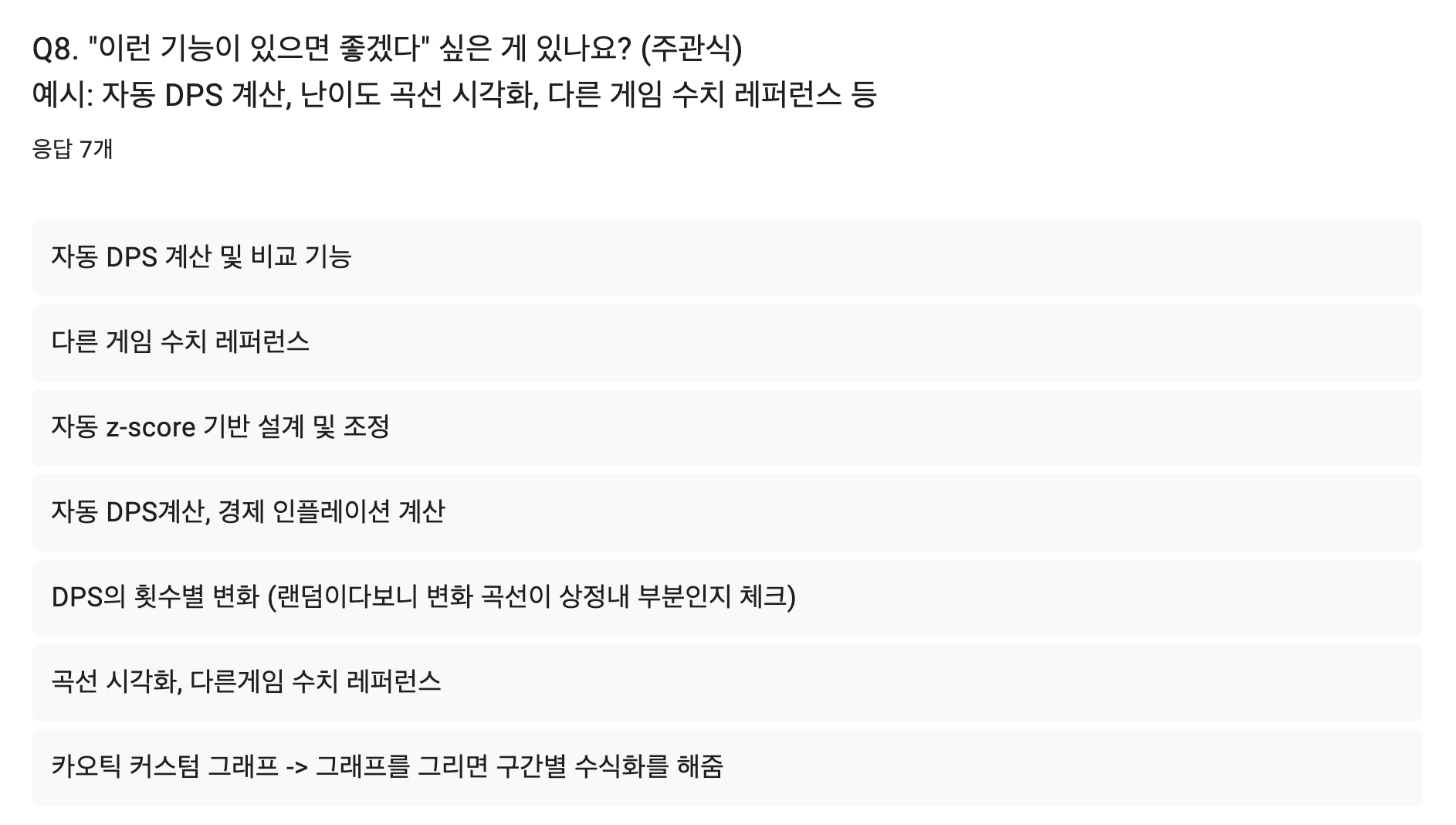
주요 의견:
- 자동 DPS 계산
- 난이도 곡선 시각화
- 다른 게임 수치 레퍼런스
분석: “자동 DPS 계산”, “난이도 곡선 시각화”는 이미 구현했어요. “다른 게임 레퍼런스”는 참고자료 섹션으로 제공할 수 있고요. 커뮤니티 기능을 추가하면 사용자 간 레퍼런스 공유로 이 니즈를 해소할 수 있어요. 전반적으로 시각화에 대한 수요가 높았어요.
3.9 사용 의향
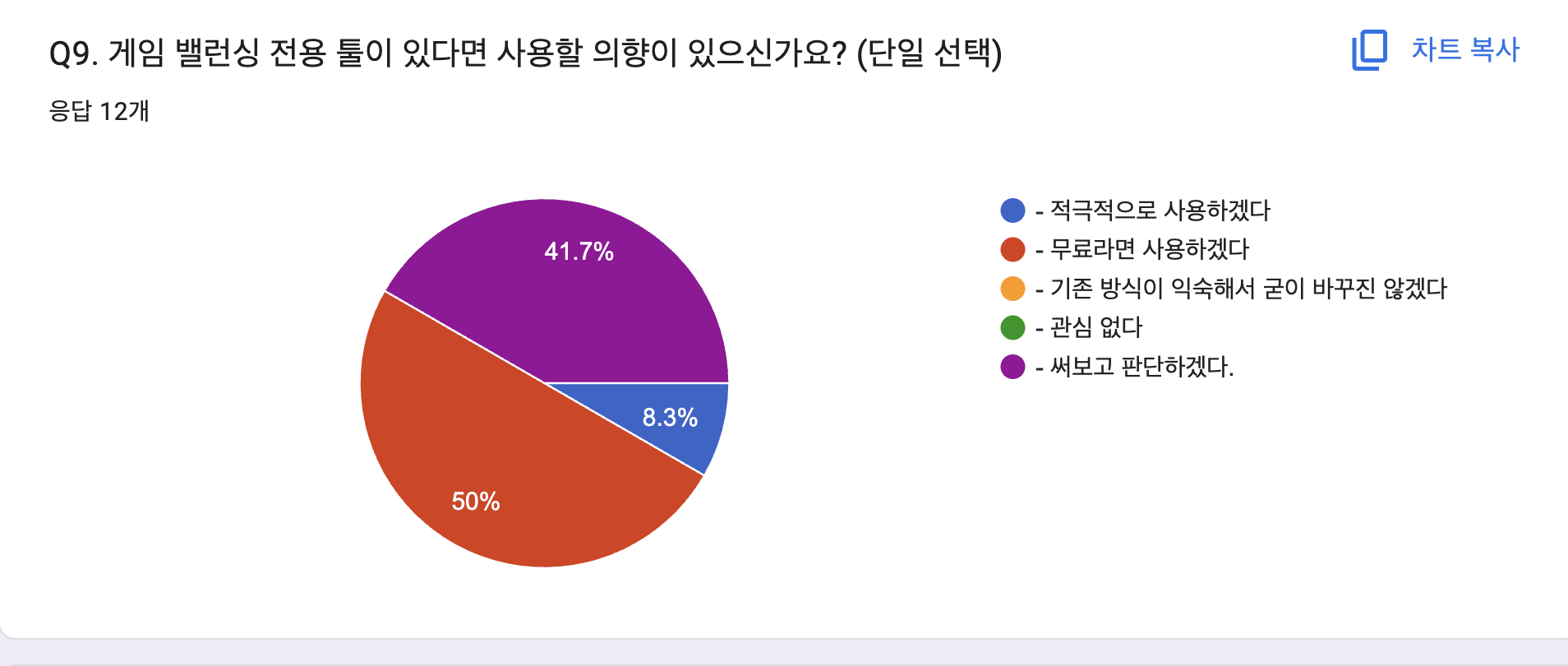
분석: 대다수가 “사용할 의향이 있다”고 응답했어요. 가설 “도구가 있으면 사용할 것이다”가 어느 정도 검증된 셈이에요.
3.10 중요하게 생각하는 것
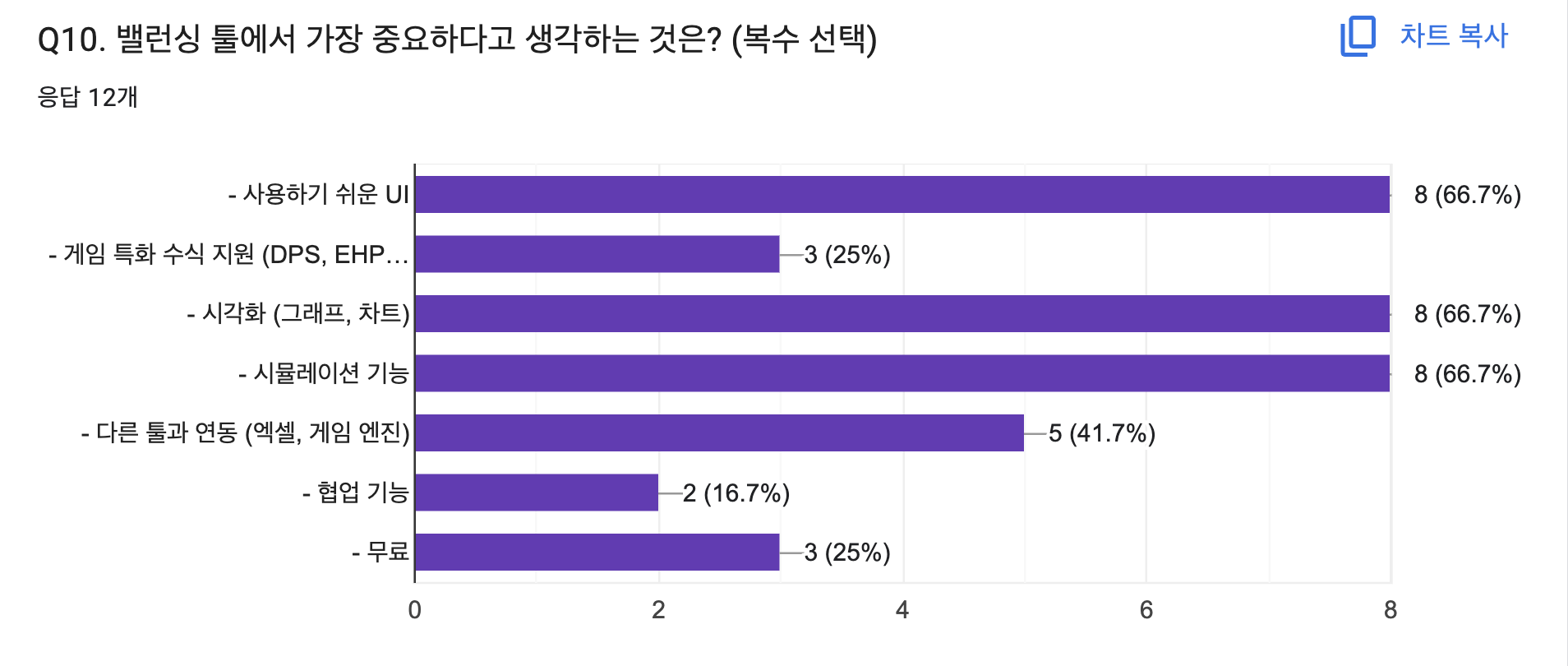
분석: 사용 편의성, 게임 엔진 연동, 시각화가 상위권이에요. 이 세 가지가 핵심 기능이 되어야 해요.
3.11 가격 민감도
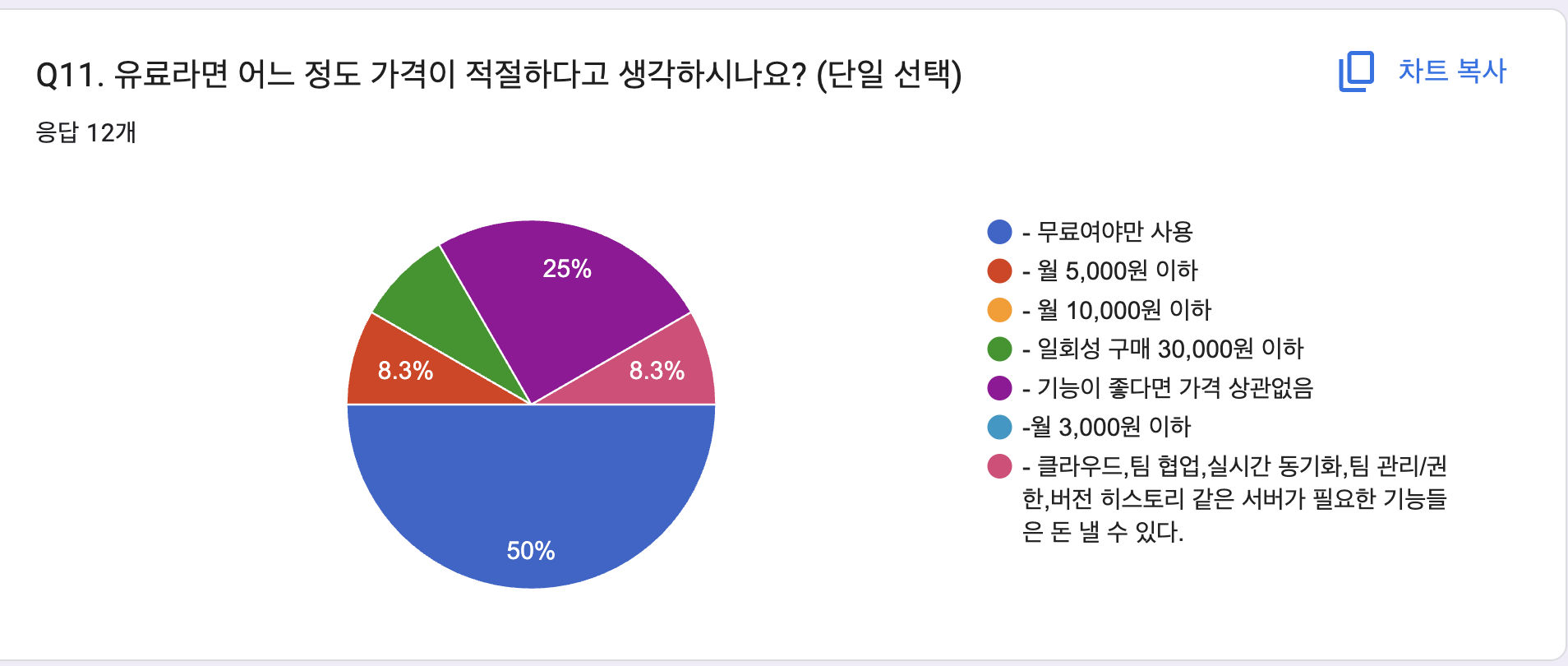
분석: 무료~월 5천원 대가 대다수예요. 고가 유료화는 어렵고, 프리미엄 모델(기본 무료 + 고급 기능 유료)이 적합하다는 증거예요.
3.12 자유 의견
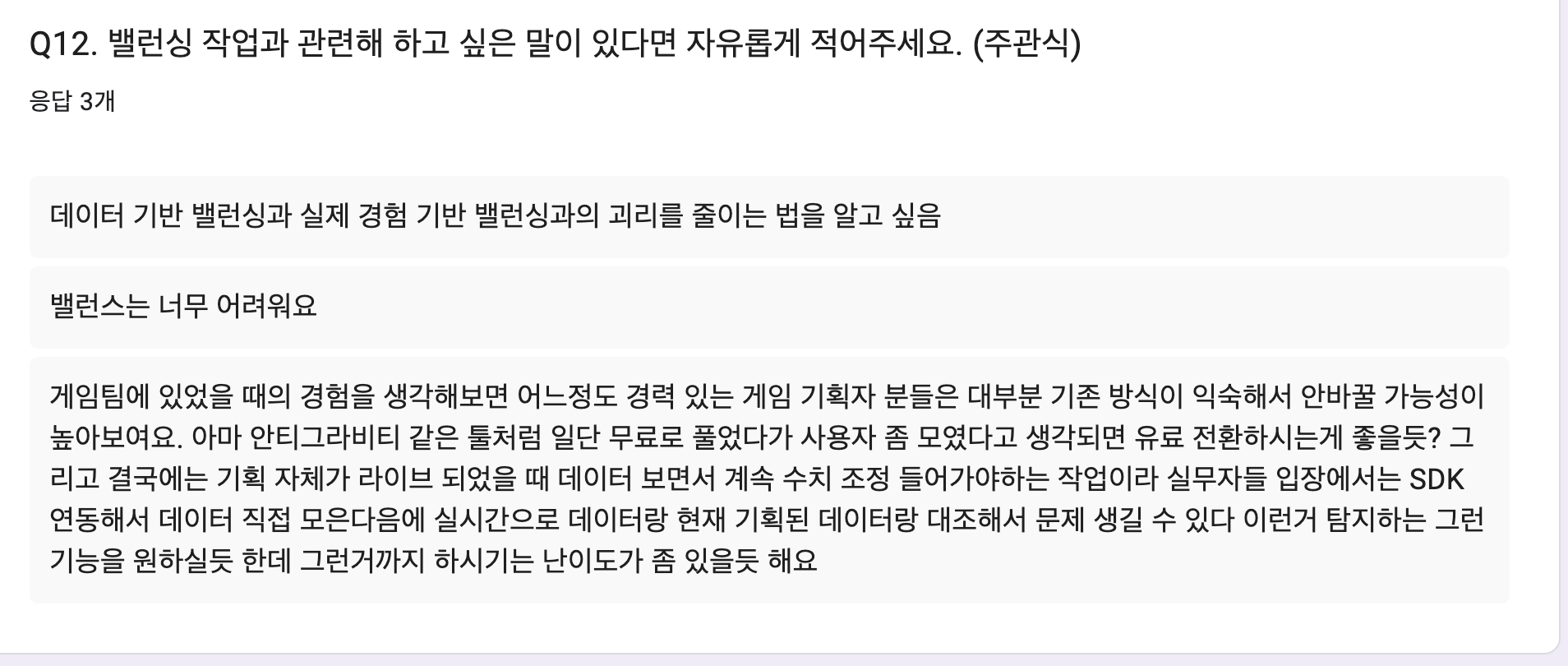
3.13 베타테스트 참여 의향

분석: 2명이 연락처를 남겼어요. 초기 사용자 확보 가능성이 있어요.
4. 상세 피드백 분석
설문 외에 개인 메시지로 받은 상세 피드백을 분석했어요.
4.1 시뮬레이션 기능 관련 피드백
Q: 피드백이라고 하기엔 애매하고… 제가 예전에 취준하면서 비슷한것 만들었을때는 시뮬레이터 쪽에 아래 같은 정보도 넣었습니다.
- 평균적으로 전투가 종료되는 시간 (전투가 늘어지는 경향이 있는지)
- 종료 시 HP 추세 (적은 피로 이기면 더 쫄깃하기도 하니까)
- 치명타 관련 정보들 (치명타에 의해서 얼마나 게임이 뒤집혔는지)
외적인 기능엔
- 파티플레이
- 전투 스킬 (공격, 범위 공격, 힐, 범위 힐, 무적 등)
- 시뮬레이션 데이터 결과 export
분석:
- 전투 종료 시간, 종료 시 HP 추세는 “게임 페이스”를 분석하는 지표예요
- 치명타 역전 분석은 “운 요소”의 영향을 측정하는 거고요
- 파티플레이는 현재 N:N 팀 전투로 구현돼 있어요
- 스킬 시스템은 부분 구현(쿨타임, HP 트리거)했고, 무적/부활은 미구현이에요
- 결과 export는 구현 예정이에요
액션 아이템:
- 전투 로그 export 기능 추가
- 평균 전투 시간, 종료 시 HP 분포 시각화 추가 검토
4.2 이상치 탐지 관련 피드백
Q: 개인적으로는 저런 검증툴은 실제적인 전투 감각 텐션 검증은 어렵다고 생각해요. 그래서 저런 것이 대신 해주면 좋은 것은 이상점 탐지라고 봅니다.
버프가 무지막지하게 튀는 지점이 있는지? DPS가 의도보다 너무 높아지는 구간이 있는지?
개체 A가 가진 스탯을 모든 프레임이나 턴을 기반으로 그래프화해서 보여주면 유리한 점이 있을겁니다.
분석:
- “실제 전투 감각 검증은 어렵다”는 것은 맞는 지적이에요. 이 도구가 “모든 것을 해결해준다”고 주장하면 안 돼요.
- 핵심 가치는 “이상치 탐지”예요. Z-score 기반 이상치 탐지 기능이 이미 있지만, 프레임별 스탯 변화 그래프는 추가 검토가 필요해요.
Q: 리얼 밸런스를 저 툴로 다 맞춘다하면 그야말로 지옥이라서요. 그건 내려놓고 할 수 있는 부분을 최대한 커버하는 쪽으로 가시면 효율이 좋아질듯. 그것만 해도 엄청난 툴이 됩니다.
분석:
- 범위 설정이 중요해요. “만능 툴”이 아니라 “특정 문제를 확실히 해결하는 툴”로 포지셔닝해야 해요.
- 명시적으로 “하지 않는 것”을 문서화해야 해요.
4.3 확장성 관련 피드백
Q: 게임마다 밸런스의 특성이 다르고 비표준적인 작업을 해야 할 경우가 많다고 생각해서요.
A. 레벨업 요구 경험치가 지수적으로 증가하지만, 10렙부터 50렙까지는 레벨업당 요구 경험치가 10만으로 일정한 그래프가 있어도 대응할 수 있는가?
B. 무적 스킬의 쿨타임이 0초라거나 사망시 90%확률로 부활하는 캐릭터라면 그 때의 승률은 어떤지?
분석:
- A 케이스: “구간별 성장 곡선”이 필요해요. 현재는 단일 곡선만 지원하고, 로드맵에 추가했어요.
- B 케이스: 특수 효과(무적, 부활)는 현재 미지원이에요. 커스텀 스크립트 기능으로 해결할 수 있을 것 같아요.
Q: 약간 캡슐화된 기능들의 조합 방식으로 간다거나, 접근 방식을 뒤집는 것도 상상해 볼 수 있을 것 같아요.
예를들면 성장그래프 개형을 ‘드로잉’ 하면 구간별로 나눠서 구간별 공식을 도출해주는 역순의 접근법이라거나요..
분석:
- “역방향 계산” (Goal Solver) 기능이에요. “원하는 결과를 입력하면 필요한 수치를 역산”하는 기능이죠.
- 이미 Goal Solver 기능이 있지만, “드로잉 → 공식 도출”은 더 직관적인 UX예요. 장기 로드맵에 추가했어요.
4.4 수익화 관련 피드백
Q: 지속적이고 반복적인 수요가 발생하는 지점을 노려 강화하시면 좋을것 같습니다.
4~5년에 1번 사용할 굉장히 유용하고 신기한 기능보다는…
매번 업데이트마다 밸런스 검증의 수요라던지, 신작 게임 개발사에서 한번쯤 테스트해볼만한 밸런스 기반 플레이타임(볼륨) 산출 도우미라던지요!
분석:
- “반복 수요”가 핵심이에요. 한 번 쓰고 끝나는 기능보다 “매번 업데이트마다 쓰는 기능”이 유료화에 적합하거든요.
- 밸런스 검증(패치 전 시뮬레이션), 버전 비교(이전 버전 vs 새 버전) 기능이 반복 수요를 만들 수 있어요.
5. 비판적 피드백과 대응
5.1 받은 비판
Q: 의도는 알겠는데 쉽지않을거같음
- 엑셀처럼 자유로운 사용방식과 최대한 비슷해야 기획자가 쓸려고함 (언리얼테이블조차 잘안쓸려하더라)
- 엑셀에 익숙하고 비쥬얼베이직도 조금다루는사람이 넘어갈만한 메리트가 안보임
현상태는 포폴로써는 좋아보이지만 이걸 사업비전으로하는건 메리트를 못느낌
인디겜개발자 수준에서는 필요할수도있지만 유료로 쓰지않을거고 어느정도 회사크기가 있게되면 확장성이 최우선이기때문에 유지보수가 쉬워야함
5.2 비판 분석
| 비판 | 타당성 | 대응 |
|---|---|---|
| 엑셀처럼 자유로워야 함 | O | UI를 스프레드시트 형태로 설계함 |
| VBA 사용자가 넘어갈 메리트 없음 | △ | VBA로 직접 만들 수 있는 사람은 타겟이 아님. “직접 만들 시간이 없는 사람”이 타겟 |
| 인디 개발자는 유료로 안 씀 | O | 기본 기능 무료, 클라우드 기능만 유료 (Open Core 모델) |
| 확장성이 최우선 | O | 오픈소스로 공개하여 직접 수정 가능하게 함 |
5.3 타겟 재정의
비판을 반영하여 타겟을 명확히 했어요:
타겟:
- 1~5인 규모의 인디 개발자/팀
- 전담 밸런스 디자이너가 없는 환경
- 엑셀은 쓰지만 VBA 스크립트를 직접 짤 시간/역량이 없는 사람
- “이 정도면 충분하다”는 80% 솔루션을 원하는 사람
타겟이 아닌 사람:
- 대형 스튜디오
- VBA/Apps Script를 자유자재로 다루는 사람 (직접 만드는 게 나음)
- 100% 커스텀이 필요한 사람 (확장성 한계)
다만 인디 개발자/팀에서 출발하되, 장기적으로는 대형 스튜디오에서도 사용할 수 있는 수준으로 확장하는 것이 목표예요.
6. 설문 결과 기반 의사결정
설문조사와 피드백을 바탕으로 다음 결정을 내렸어요.
6.1 핵심 기능 우선순위
| 우선순위 | 기능 | 근거 |
|---|---|---|
| 1 | 사용 편의성 (스프레드시트 UI) | 설문 Q10 1위 |
| 2 | 게임 엔진 연동 | 설문 Q10 2위 |
| 3 | 시각화 | 설문 Q10 3위 |
| 4 | DPS/EHP/TTK 자동 계산 | 설문 Q8 주관식 |
| 5 | 시뮬레이션 | 커뮤니티 반응 |
6.2 수익 모델
| 구분 | 기능 | 가격 |
|---|---|---|
| 무료 | 모든 로컬 기능, 수식, 시뮬레이션, 내보내기 | 0원 |
| 유료 | 클라우드 저장, 버전 히스토리, 팀 협업 | 월 5,000원 이하 |
근거: 설문 Q11에서 대다수가 “무료~월 5천원”을 선택
6.3 명시적으로 하지 않는 것
피드백 “리얼 밸런스를 다 맞추는 건 지옥”을 반영:
- 게임을 만들어주는 도구가 아니에요
- AI가 밸런스를 자동으로 잡아주지 않아요 (이상치 탐지만 해요)
- 모든 게임의 모든 케이스를 커버하지 않아요 (80% 솔루션)
- 게임 엔진 플러그인이 아니에요 (데이터 내보내기만 제공)
7. 추가 반응: 러브콜
프로젝트를 홍보하면서 예상치 못한 반응도 있었어요:
- “프로젝트 상용화를 위해 뛰어다니는 게 맘에 들었다”
- “사원 수 100명 이상, 캐주얼 게임 운영 중인 회사에서 본격적으로 만들어보는 건 어떻겠냐”
이런 반응은 “시장에서 이 문제를 인식하고 있다”는 신호로 해석했어요.
8. 결론: 무엇을 배웠는가
8.1 확인된 긍정 신호
- 문제는 실재해요: 인디 개발자들이 밸런싱 도구의 부재를 느끼고 있어요
- 관심은 있어요: 홍보 시 즉각적인 긍정 반응이 있었어요
- 사용 의향은 있어요: 설문에서 대다수가 “사용하겠다”고 응답했어요
다만 12명이라는 표본 크기의 한계가 있으므로, 이 결과는 통계적 검증이 아닌 초기 방향성 확인으로 해석했어요.
8.2 주의할 것
- “관심”과 “실제 사용”은 달라요: 출시 후 실제 사용률을 봐야 해요
- 유료 전환은 어려워요: 무료 기능이 충분하면 굳이 돈을 안 내거든요
- 범위 설정이 중요해요: “만능 툴”을 목표로 하면 안 돼요
8.3 다음 단계
- MVP 출시 → 실제 사용 데이터 수집
- 피드백 기반 개선 (구간별 성장 곡선, 전투 로그 export 등)
- 클라우드 기능 개발 → 유료화 테스트
1. Problem Recognition: Why This Project Started
1.1 Observed Pattern
While observing indie game development communities and from personal experience developing indie games, a recurring pattern was discovered.
Pattern:
- Developer sets character HP to 1500
- No confidence whether “this is the right number”
- Adjusts by “feel” through playtesting
- Post-launch user feedback: “This character is too OP”
- Emergency hotfix
Why this happens:
- Large studios have dedicated balance designers and internal tools
- 1-2 person indie developers lack those resources
- Even large studios using Excel/Google Sheets struggle without game-specific functions
1.2 Problem Definition
| Problem | Specific Situation | Why It’s a Problem |
|---|---|---|
| No basis for values | Don’t know if HP 1500 is appropriate | Forget why this number was chosen over time |
| Difficulty validating | Testing balance when units fight one by one | Manual testing impossible as combinations grow |
| Lack of tools | Game formulas, simulation, visualization scattered | Need separate Excel, simulator, charting tools |
1.3 Hypothesis
“If there’s a tool that auto-calculates game formulas like DPS/EHP/TTK, validates win rates through simulation, and auto-detects anomalies, indie developers will use it.”
Market research was conducted to validate this hypothesis.
2. Market Research: Hypothesis Exploration
2.1 Research Method
- Target: Indie game development open chat room (2,200 members, many working professionals)
- Method: Survey + community reaction collection
- Duration: Approximately 1 week
2.3 Immediate Community Response
Responses from the 2,200-member room were compiled.
Positive reactions:
- “This is interesting”
- “Can I use it now?”
- “When can I try it?”
- “Wow, you’re building something really cool”
- “I’m happy just knowing it has dark theme”
Technical questions:
Q: Does the combat calculation run frame-by-frame? Or is it turn-based only?
A: Currently runs on frame (time) basis. Usable for turn-based games too, but designed with real-time combat balancing in mind for FPS, MOBA, action RPGs.
Q: In the difficulty curve design section, can the baseline adjustments be customized to user intent?
A: Yes. But it’s still in early stages and being refined.
Analysis: Immediate interest proves “people experiencing this problem exist.” However, “interest” and “actual usage” differ, so deeper investigation was done through surveys.
3. Survey Results Analysis
12 people responded when posted to the 2,200-member room. Getting 12 responses without incentives (gift cards, etc.) was interpreted as a signal of interest.
3.1 Respondent Profile
| Role | Count |
|---|---|
| Working professionals | 6 |
| Students/Job seekers | 2 |
| Solo indie developers | 2 |
| Hobby developers | 1 |
| Indie team developers | 1 |
Analysis: Half the respondents are working professionals. People who actually do balancing work showed interest.
3.2 Genres in Development
Analysis: Roguelike, RPG, and simulation ranked highest. The common trait: “numerical balancing is critical.” Genre characteristics signal the target users are correct.
3.3 Development Experience
Analysis: 10 out of 12 have completed/shipped projects. These are “people who’ve actually done balancing work.” More credible than opinions from inexperienced respondents.
3.4 Current Tools Used
Analysis: Majority use Excel/Google Sheets. Solving these tools’ limitations creates switching potential. Some use Unity Inspector, showing a desire to “solve it within the engine.”
Additional comment: “Unreal tables are annoying for planners doing large-scale work”
→ Evidence of dissatisfaction with existing tools
3.5 Pain Points with Current Methods
Analysis: This question’s responses are key. Directly shows “what inconveniences need to be solved.”
3.6 Balancing Difficulties
Analysis: “Hard to verify if balance is correct” is the core pain point. This justifies the Monte Carlo simulation feature.
3.7 Information Sources
Analysis: Reference game analysis, communities, and YouTube ranked highest. This means “there’s no systematic learning path.” Providing theoretical background could be a differentiator.
3.8 Desired Features (Open-ended)
Key opinions:
- Auto DPS calculation
- Difficulty curve visualization
- Other game value references
Analysis: “Auto DPS calculation” and “difficulty curve visualization” are already implemented. “Other game references” can be provided through a references section. Adding community features could address this need through user-to-user reference sharing. Overall, high demand for visualization.
3.9 Usage Intent
Analysis: Majority responded “willing to use.” This provides an early positive signal for the hypothesis “they’ll use it if it exists,” though the small sample size limits definitive conclusions.
3.10 What Matters Most
Analysis: Ease of use, game engine integration, and visualization ranked highest. These three should be core features.
3.11 Price Sensitivity
Analysis: Free to 5,000 KRW/month dominated. High-price monetization is difficult; evidence supports a freemium model (basic free + premium features paid).
3.12 Free Comments
3.13 Beta Test Participation
Analysis: 2 people left contact information. Early user acquisition is possible.
4. Detailed Feedback Analysis
Detailed feedback received via personal messages beyond the survey was analyzed.
4.1 Simulation Feature Feedback
Analysis:
- Combat end time and ending HP trends are metrics for analyzing “game pace”
- Critical hit reversal analysis measures “luck factor” impact
- Party play is currently implemented as NvN team battles
- Skill system partially implemented (cooldowns, HP triggers); invincibility/resurrection not yet
- Result export is planned
Action items:
- Add combat log export feature
- Review adding average combat time and ending HP distribution visualization
4.2 Anomaly Detection Feedback
Analysis:
- “Actual combat feel validation is difficult” is a valid point. The tool shouldn’t claim to “solve everything.”
- Core value is “anomaly detection.” Z-score based detection exists, but frame-by-frame stat change graphs need review.
- Scope setting matters. Position as “a tool that definitively solves specific problems,” not a “universal tool.”
- Explicitly document “what it doesn’t do.”
4.3 Extensibility Feedback
Analysis:
- Case A: “Range-based growth curves” needed. Currently only single curves supported. Added to roadmap.
- Case B: Special effects (invincibility, resurrection) currently unsupported. May be solvable with custom scripting.
- “Reverse calculation” (Goal Solver) feature. Goal Solver exists, but “drawing → formula derivation” is more intuitive UX. Added to long-term roadmap.
4.4 Monetization Feedback
Analysis:
- “Recurring demand” is key. Features used “every update” suit paid tiers better than one-time-use features.
- Balance validation (pre-patch simulation), version comparison (old vs new) can create recurring demand.
5. Critical Feedback and Response
5.1 Criticism Received
Feedback essentially said: intent is clear but execution will be difficult. Excel-like freedom is needed, VBA users see no merit in switching, indie developers won’t pay, and larger companies need extensibility and maintainability.
5.2 Criticism Analysis
| Criticism | Validity | Response |
|---|---|---|
| Must be free like Excel | O | UI designed as spreadsheet format |
| No merit for VBA users to switch | △ | VBA-capable users aren’t the target. Target is “people without time to build their own” |
| Indie developers won’t pay | O | Basic features free, only cloud features paid (Open Core model) |
| Extensibility is top priority | O | Open-sourced for direct modification |
5.3 Target Redefinition
Targets were clarified reflecting criticism:
Target:
- 1-5 person indie developers/teams
- Environments without dedicated balance designers
- People who use Excel but lack time/ability to write VBA scripts
- People wanting an “80% solution that’s good enough”
Not the target:
- Large studios
- People fluent in VBA/Apps Script (better off building their own)
- People needing 100% customization (extensibility limitations)
Starting with indie developers/teams, the long-term goal is expanding to a level usable by large studios.
6. Survey-Based Decisions
Based on surveys and feedback, the following decisions were made.
6.1 Core Feature Priority
| Priority | Feature | Basis |
|---|---|---|
| 1 | Ease of use (spreadsheet UI) | Survey Q10 #1 |
| 2 | Game engine integration | Survey Q10 #2 |
| 3 | Visualization | Survey Q10 #3 |
| 4 | DPS/EHP/TTK auto calculation | Survey Q8 open-ended |
| 5 | Simulation | Community response |
6.2 Revenue Model
| Tier | Features | Price |
|---|---|---|
| Free | All local features, formulas, simulation, export | 0 KRW |
| Paid | Cloud storage, version history, team collaboration | Under 5,000 KRW/month |
Basis: Majority selected “free to 5,000 KRW” in survey Q11
6.3 Explicitly Not Doing
Reflecting the feedback “perfectly balancing with this tool would be hell”:
- Not a tool that makes games
- AI doesn’t auto-balance (only anomaly detection)
- Doesn’t cover every case for every game (80% solution)
- Not a game engine plugin (only data export)
7. Unexpected Responses
While promoting the project, unexpected reactions emerged:
- “I like that you’re hustling to commercialize the project”
- “How about building it seriously at a company with 100+ employees running casual games?”
These reactions were interpreted as signals that “the market recognizes this problem.”
8. Conclusion: What Was Learned
8.1 Positive Signals Confirmed
- The problem is real: Indie developers feel the absence of balancing tools
- Interest exists: Immediate positive reactions when promoted
- Usage intent exists: Majority responded “willing to use” in surveys
With only 12 respondents, these results represent early directional signals rather than statistically validated conclusions.
8.2 Caveats
- “Interest” and “actual usage” differ: Need to observe actual usage rates post-launch
- Paid conversion is difficult: If free features are sufficient, people won’t pay
- Scope setting is critical: Don’t aim for a “universal tool”
8.3 Next Steps
- MVP launch → collect actual usage data
- Feedback-based improvements (range-based growth curves, combat log export, etc.)
- Cloud feature development → monetization testing

댓글
댓글 수정/삭제는 GitHub Discussions에서 가능합니다.