예외 처리 설계
목차
왜 이 방식을 선택했는가
1. 다른 방법들과 비교
Spring에서 예외를 처리하는 방법은 여러 가지가 있습니다. 검토한 것들을 정리합니다.
@ResponseStatus: 간단하지만 sendError()로 HTML 에러 페이지가 반환되어 REST API에 부적합합니다.
ResponseStatusException: 프로토타이핑에 빠르지만, 여러 컨트롤러에서 같은 로직이 반복되고 Service 레이어에서 던지기 애매합니다.
@ExceptionHandler (컨트롤러 레벨): 해당 컨트롤러 안에서는 잘 동작하지만, 다른 컨트롤러에서 재사용이 안 됩니다.
@ControllerAdvice (전역): 모든 컨트롤러에 적용되고 통일된 응답 포맷을 보장합니다. 예외가 어디서 처리되는지 추적이 약간 어려울 수 있지만, Spring 개발자라면 익숙한 패턴입니다.
Zalando Problem: RFC 9457을 완벽 지원하고 기본 핸들러 20개 이상을 제공하지만, 외부 라이브러리 의존성이 추가되고 1인 프로젝트에는 과합니다.
Vavr Either/Try: 함수형으로 에러를 값으로 반환하는 방식입니다. 명시적이지만 러닝 커브가 높고 Spring 생태계와 맞지 않습니다.
2. @ControllerAdvice + 커스텀 예외 선택
선택 기준
| 항목 | 중요도 |
|---|---|
| 구현 단순함 | 1등 |
| 외부 의존성 최소화 | 2등 |
| 일관된 응답 포맷 | 3등 |
| 확장 가능성 | 4등 |
| 표준 준수 (RFC 9457) | 5등 |
결정
ResponseStatusException -> 코드 중복, 통일성 없음Zalando Problem -> 외부 라이브러리, 오버스펙Vavr Either -> 러닝 커브, Spring과 안 맞음@ControllerAdvice -> 단순하고, 표준적이고, 확장 가능1인 프로젝트에서 가장 실용적인 선택은 Spring 기본 기능인 @ControllerAdvice입니다.
- 외부 라이브러리 없음
- Spring 개발자라면 누구나 이해
- 필요하면 나중에 RFC 9457로 마이그레이션 가능
3. 내부 동작 원리
@ControllerAdvice가 어떻게 동작하는지 구현하면서 알게 된 부분을 정리합니다.
예외 해결 순서
예외가 발생하면 Spring의 HandlerExceptionResolverComposite가 순서대로 Resolver를 실행한다:
- ExceptionHandlerExceptionResolver (order = 0):
@ExceptionHandler메서드 실행 - ResponseStatusExceptionResolver (order = 1):
@ResponseStatus어노테이션 확인 - DefaultHandlerExceptionResolver (order = MAX_VALUE): Spring 내장 예외를 HTTP 상태 코드로 변환
같은 예외를 처리하는 핸들러가 여러 개면 Controller 내부 @ExceptionHandler가 최우선이고, 그다음이 @ControllerAdvice입니다.
@ControllerAdvice 예외 매칭
throw new EntityNotFoundException("User not found");이 예외가 발생하면 정확히 일치하는 핸들러를 먼저 찾고, 없으면 EntityNotFoundException → BusinessException → RuntimeException → Exception 순서로 상위 클래스를 타고 올라가며 가장 구체적인 핸들러가 선택됩니다.
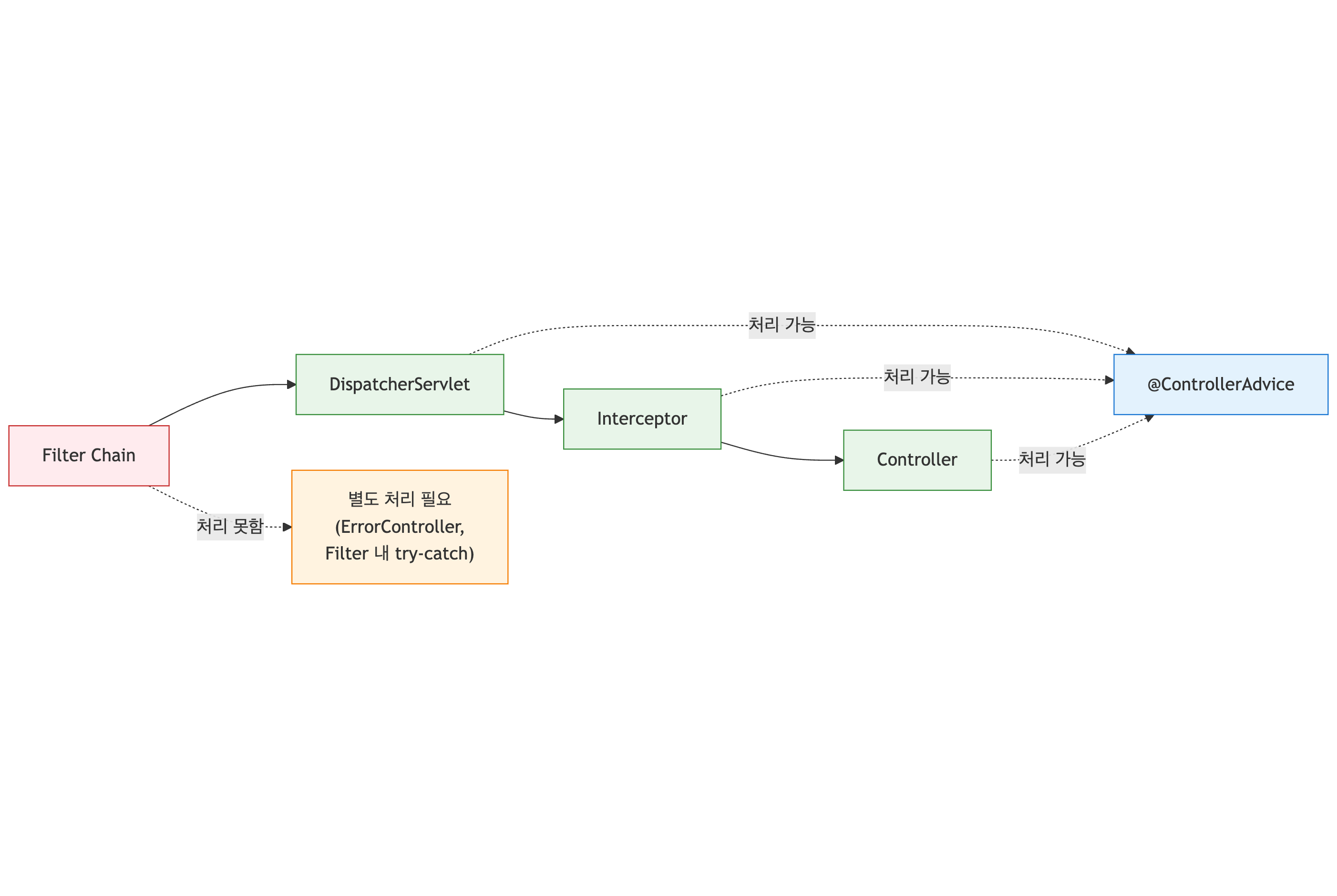
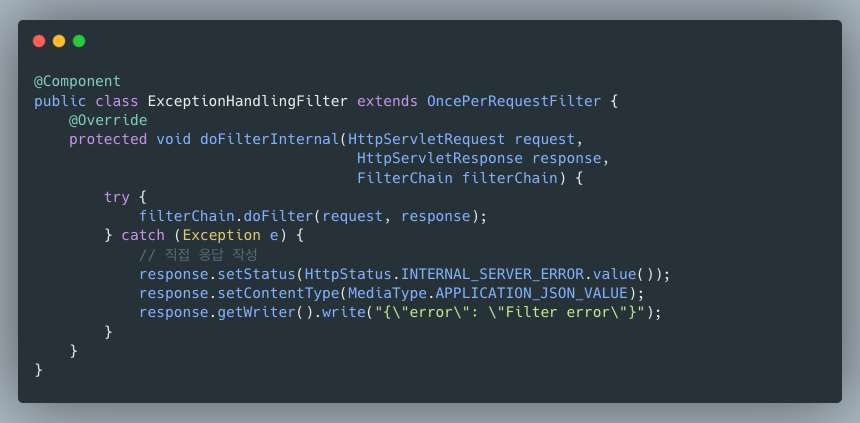
Filter 예외는 별도 처리가 필요합니다
@ControllerAdvice는 DispatcherServlet 이후에만 동작합니다. JWT 인증 필터 같은 Filter에서 발생한 예외는 @ControllerAdvice로 잡히지 않습니다.
Filter에서는 직접 try-catch로 에러 응답을 작성하거나, /error로 포워딩해서 BasicErrorController가 처리하게 해야 합니다.
4. 커스텀 에러 코드가 필요한 이유
HTTP 상태 코드만으로는 부족합니다
REST API에서 에러가 발생하면 HTTP 상태 코드를 반환합니다.
400 Bad Request401 Unauthorized404 Not Found500 Internal Server Error문제는 같은 상태 코드여도 원인이 다를 수 있다는 것입니다.
404 Not Found├── 사용자를 찾을 수 없음├── 파일을 찾을 수 없음└── 게시글을 찾을 수 없음클라이언트 입장에서 404만 받으면 뭐가 없는 건지 알 수 없습니다.
Google API Design 가이드에서도 “Errors therefore become a key tool providing context and visibility into how to use an API”라고 강조합니다.
출처: RESTful API Design: What About Errors? - Google Cloud Blog
클라이언트가 에러를 구분할 수 있습니다
{ "success": false, "error": { "code": "U001", "message": "사용자를 찾을 수 없습니다" }}{ "success": false, "error": { "code": "F001", "message": "파일을 찾을 수 없습니다" }}같은 404여도 U001과 F001로 구분할 수 있습니다.
에러 코드로 분기 처리 가능
// 클라이언트 코드if (error.code === 'A002') { // 토큰 만료 → 리프레시 토큰으로 재발급 시도 await refreshToken();} else if (error.code === 'A003') { // 유효하지 않은 토큰 → 로그인 페이지로 이동 navigateTo('/login');}HTTP 상태 코드만으로는 이런 세밀한 분기가 어렵습니다.
다국어 지원이 쉽습니다
const errorMessages = { 'U001': { ko: '사용자를 찾을 수 없습니다', en: 'User not found' }, 'A002': { ko: '토큰이 만료되었습니다', en: 'Token has expired' }};에러 코드를 키로 사용해서 다국어 메시지를 매핑할 수 있습니다.
5. RFC 9457 (Problem Details) 표준
현대 API는 RFC 9457 Problem Details 표준을 따르는 것이 권장됩니다. Spring Framework 6.0+에서 기본 지원합니다.
{ "type": "https://example.com/errors/user-not-found", "title": "User Not Found", "status": 404, "detail": "사용자 ID 123을 찾을 수 없습니다", "instance": "/users/123"}Spring Boot에서 활성화:
spring: mvc: problemdetails: enabled: true이 프로젝트에서는 RFC 9457을 완전히 따르지 않고, 단순화된 커스텀 응답 포맷을 사용합니다. 필요시 마이그레이션 가능합니다.
6. 에러 코드 네이밍 규칙
[도메인 prefix][순번]| Prefix | 도메인 | 예시 |
|---|---|---|
| C | Common (공통) | C001, C002 |
| A | Auth (인증) | A001, A002 |
| U | User (사용자) | U001, U002 |
| F | File/Upload (파일) | F001, F002 |
현재 정의된 에러 코드
Common (C)
| 코드 | HTTP | 설명 |
|---|---|---|
| C001 | 400 | 잘못된 입력값 |
| C002 | 404 | 엔티티를 찾을 수 없음 |
| C003 | 500 | 서버 내부 오류 |
| C004 | 405 | 허용되지 않은 HTTP 메서드 |
| C005 | 403 | 접근 권한 없음 |
Auth (A)
| 코드 | HTTP | 설명 |
|---|---|---|
| A001 | 401 | 이메일/비밀번호 불일치 |
| A002 | 401 | 토큰 만료 |
| A003 | 401 | 유효하지 않은 토큰 |
| A004 | 401 | 리프레시 토큰 없음 |
| A005 | 401 | 인증 필요 |
User (U)
| 코드 | HTTP | 설명 |
|---|---|---|
| U001 | 404 | 사용자 없음 |
| U002 | 409 | 이메일 중복 |
| U003 | 409 | 닉네임 중복 |
| U004 | 400 | 이미 탈퇴한 사용자 |
| U005 | 403 | 정지된 사용자 |
| U006 | 403 | 차단된 사용자 |
Upload (F)
| 코드 | HTTP | 설명 |
|---|---|---|
| F001 | 404 | 파일 없음 |
| F002 | 400 | 파일 크기 초과 |
| F003 | 400 | 지원하지 않는 형식 |
| F004 | 500 | 업로드 실패 |
| F005 | 400 | 이미 삭제된 파일 |
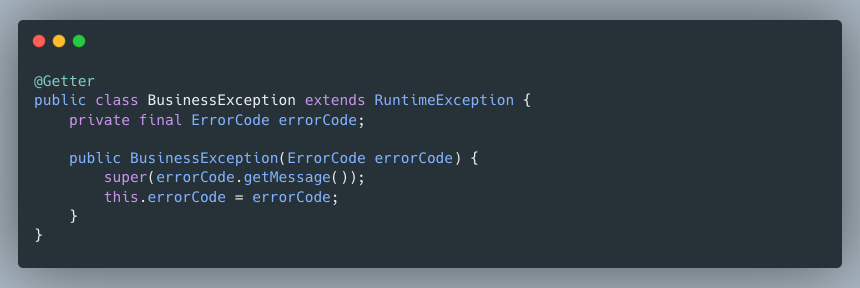
7. 예외 클래스 구조
RuntimeException └── BusinessException (비즈니스 예외 기본 클래스) └── EntityNotFoundException (404 전용)BusinessException
모든 비즈니스 예외의 부모 클래스.
사용 예시
// 서비스 레이어if (userRepository.existsByEmail(email)) { throw new BusinessException(ErrorCode.DUPLICATE_EMAIL);}
// 404 전용User user = userRepository.findById(id) .orElseThrow(() -> new EntityNotFoundException(ErrorCode.USER_NOT_FOUND));8. GlobalExceptionHandler
@RestControllerAdvice는 모든 컨트롤러에서 발생하는 예외를 한 곳에서 처리할 수 있게 해줍니다.
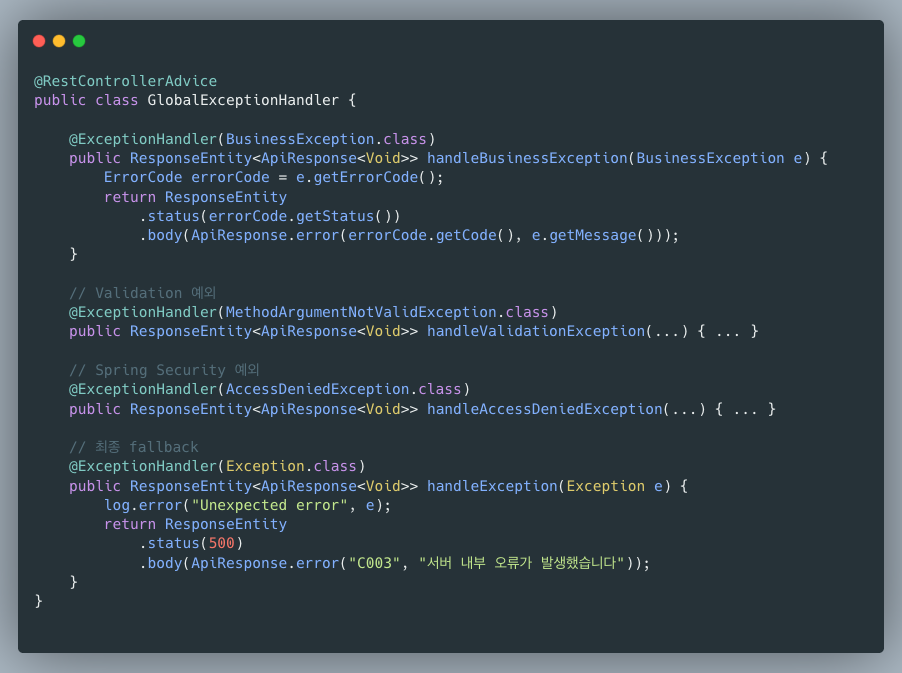
처리하는 예외 목록
| 예외 | HTTP | 설명 |
|---|---|---|
| EntityNotFoundException | 404 | 엔티티 없음 |
| BusinessException | 동적 | 비즈니스 로직 예외 |
| MethodArgumentNotValidException | 400 | @Valid 검증 실패 |
| MissingServletRequestParameterException | 400 | 필수 파라미터 누락 |
| MethodArgumentTypeMismatchException | 400 | 파라미터 타입 불일치 |
| IllegalArgumentException | 400 | 잘못된 인자 |
| IllegalStateException | 409 | 잘못된 상태 |
| AccessDeniedException | 403 | 접근 거부 |
| AuthenticationException | 401 | 인증 실패 |
| HttpRequestMethodNotSupportedException | 405 | HTTP 메서드 불일치 |
| MaxUploadSizeExceededException | 400 | 파일 크기 초과 |
| Exception | 500 | 그 외 모든 예외 |
출처: Spring Boot Global Exception Handling with @RestControllerAdvice - Jose López
9. 통일된 응답 포맷
ApiResponse
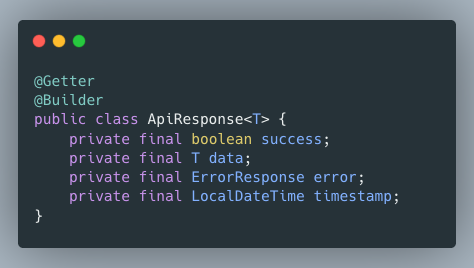
성공 응답
{ "success": true, "data": { "id": 1, "nickname": "홍길동" }, "timestamp": "2025-12-15T10:30:00"}실패 응답
{ "success": false, "error": { "code": "U002", "message": "이미 사용 중인 이메일입니다" }, "timestamp": "2025-12-15T10:30:00"}Validation 실패 응답 (상세 정보 포함)
{ "success": false, "error": { "code": "C001", "message": "입력값 검증에 실패했습니다", "details": { "email": "이메일 형식이 올바르지 않습니다", "password": "비밀번호는 8자 이상이어야 합니다" } }, "timestamp": "2025-12-15T10:30:00"}출처: Best Practices for Consistent API Error Handling - Zuplo
10. 보안 고려사항
프로덕션 환경에서는 내부 정보 노출에 주의해야 합니다.
하지 말아야 할 것
{ "error": "NullPointerException at UserService.java:42", "stackTrace": "..."}스택 트레이스, 파일 경로, 라이브러리 버전 등이 노출되면 공격자에게 취약점 정보를 제공하게 됩니다.
해야 할 것
{ "code": "C003", "message": "서버 내부 오류가 발생했습니다"}내부적으로는 로그에 상세 정보를 남기고, 클라이언트에는 일반적인 메시지만 반환합니다.
11. 에러 코드 추가 방법
새로운 도메인이 생기면:
1. ErrorCode에 추가
public enum ErrorCode { // ... 기존 코드
// Study (새 도메인) STUDY_NOT_FOUND(404, "S001", "스터디를 찾을 수 없습니다"), STUDY_ALREADY_STARTED(400, "S002", "이미 시작된 스터디입니다");}2. 서비스에서 사용
throw new BusinessException(ErrorCode.STUDY_NOT_FOUND);GlobalExceptionHandler는 수정할 필요 없습니다. BusinessException을 상속하면 자동으로 처리됩니다.
참고 자료
- Spring Rest - Exception Handling - DEV Community
- Exception Handling in Spring MVC - Spring 공식 블로그
- Spring Boot @ControllerAdvice & @ExceptionHandler - BezKoder
- zalando/problem-spring-web - GitHub
- Vavr User Guide
- RESTful API Design: What About Errors? - Google Cloud Blog
- Best Practices for API Error Handling - Postman Blog
- Error Responses - Spring Framework 공식 문서
- Spring Boot Global Exception Handling - Jose López
- REST API Error Codes 101 - REST Case
- Best Practices for Consistent API Error Handling - Zuplo
- REST API Error Handling Best Practices - Speakeasy
Why this approach was chosen
1. Comparison with Other Approaches
Spring offers several ways to handle exceptions. Here are the approaches that were evaluated.
@ResponseStatus: Simple, but it calls sendError() which returns an HTML error page, making it unsuitable for REST APIs.
ResponseStatusException: Quick for prototyping, but the same logic gets repeated across multiple controllers, and it’s awkward to throw from the Service layer.
@ExceptionHandler (controller-level): Works well within a specific controller, but cannot be reused across other controllers.
@ControllerAdvice (global): Applies to all controllers and guarantees a unified response format. Tracking where an exception is handled can be slightly difficult, but it’s a familiar pattern for Spring developers.
Zalando Problem: Fully supports RFC 9457 and provides over 20 built-in handlers, but it adds an external library dependency and is overkill for a solo project.
Vavr Either/Try: A functional approach that returns errors as values. It’s explicit, but has a steep learning curve and doesn’t fit well with the Spring ecosystem.
2. Chose @ControllerAdvice + Custom Exceptions
Selection Criteria
| Criterion | Priority |
|---|---|
| Simplicity of implementation | 1st |
| Minimize external dependencies | 2nd |
| Consistent response format | 3rd |
| Extensibility | 4th |
| Standards compliance (RFC 9457) | 5th |
Decision
ResponseStatusException -> Code duplication, no consistencyZalando Problem -> External library, overengineeredVavr Either -> Learning curve, doesn't fit Spring@ControllerAdvice -> Simple, standard, extensibleFor a solo project, the most practical choice is Spring’s built-in @ControllerAdvice.
- No external libraries
- Any Spring developer can understand it
- Can migrate to RFC 9457 later if needed
3. How It Works Internally
Here are the implementation details learned while building with @ControllerAdvice.
Exception Resolution Order
When an exception occurs, Spring’s HandlerExceptionResolverComposite runs resolvers in order:
- ExceptionHandlerExceptionResolver (order = 0): Executes
@ExceptionHandlermethods - ResponseStatusExceptionResolver (order = 1): Checks for
@ResponseStatusannotations - DefaultHandlerExceptionResolver (order = MAX_VALUE): Converts Spring built-in exceptions to HTTP status codes
If multiple handlers exist for the same exception, the controller-internal @ExceptionHandler takes highest priority, followed by @ControllerAdvice.
@ControllerAdvice Exception Matching
throw new EntityNotFoundException("User not found");When this exception is thrown, an exact match handler is searched first. If none is found, it traverses up the class hierarchy — EntityNotFoundException → BusinessException → RuntimeException → Exception — and the most specific handler is selected.
Filter Exceptions Require Separate Handling
@ControllerAdvice only works after DispatcherServlet. Exceptions thrown in Filters, such as JWT authentication filters, are not caught by @ControllerAdvice.
In Filters, you need to write error responses directly with try-catch, or forward to /error so that BasicErrorController handles it.
4. Why Custom Error Codes Are Needed
HTTP Status Codes Alone Are Not Enough
When a REST API error occurs, an HTTP status code is returned.
400 Bad Request401 Unauthorized404 Not Found500 Internal Server ErrorThe problem is that the same status code can have different causes.
404 Not Found├── User not found├── File not found└── Post not foundFrom the client’s perspective, receiving only 404 makes it impossible to know what’s missing.
Google’s API Design guide also emphasizes: “Errors therefore become a key tool providing context and visibility into how to use an API.”
Source: RESTful API Design: What About Errors? - Google Cloud Blog
Clients Can Distinguish Errors
{ "success": false, "error": { "code": "U001", "message": "User not found" }}{ "success": false, "error": { "code": "F001", "message": "File not found" }}Even with the same 404, U001 and F001 can be distinguished.
Error Code-Based Branching
// Client codeif (error.code === 'A002') { // Token expired → attempt refresh token renewal await refreshToken();} else if (error.code === 'A003') { // Invalid token → navigate to login page navigateTo('/login');}Such fine-grained branching is difficult with HTTP status codes alone.
Easy Internationalization
const errorMessages = { 'U001': { ko: '사용자를 찾을 수 없습니다', en: 'User not found' }, 'A002': { ko: '토큰이 만료되었습니다', en: 'Token has expired' }};Error codes can be used as keys to map multilingual messages.
Source: Best Practices for API Error Handling - Postman Blog
5. RFC 9457 (Problem Details) Standard
Modern APIs are recommended to follow the RFC 9457 Problem Details standard. It is natively supported in Spring Framework 6.0+.
{ "type": "https://example.com/errors/user-not-found", "title": "User Not Found", "status": 404, "detail": "Cannot find user with ID 123", "instance": "/users/123"}Enabling in Spring Boot:
spring: mvc: problemdetails: enabled: trueThis project does not fully follow RFC 9457 and uses a simplified custom response format. Migration is possible when needed.
Source: Error Responses - Spring Framework Official Documentation
6. Error Code Naming Convention
[Domain prefix][Sequence number]| Prefix | Domain | Examples |
|---|---|---|
| C | Common | C001, C002 |
| A | Auth | A001, A002 |
| U | User | U001, U002 |
| F | File/Upload | F001, F002 |
Currently Defined Error Codes
Common (C)
| Code | HTTP | Description |
|---|---|---|
| C001 | 400 | Invalid input |
| C002 | 404 | Entity not found |
| C003 | 500 | Internal server error |
| C004 | 405 | Method not allowed |
| C005 | 403 | Access denied |
Auth (A)
| Code | HTTP | Description |
|---|---|---|
| A001 | 401 | Email/password mismatch |
| A002 | 401 | Token expired |
| A003 | 401 | Invalid token |
| A004 | 401 | Refresh token missing |
| A005 | 401 | Authentication required |
User (U)
| Code | HTTP | Description |
|---|---|---|
| U001 | 404 | User not found |
| U002 | 409 | Duplicate email |
| U003 | 409 | Duplicate nickname |
| U004 | 400 | Already withdrawn user |
| U005 | 403 | Suspended user |
| U006 | 403 | Blocked user |
Upload (F)
| Code | HTTP | Description |
|---|---|---|
| F001 | 404 | File not found |
| F002 | 400 | File size exceeded |
| F003 | 400 | Unsupported format |
| F004 | 500 | Upload failed |
| F005 | 400 | Already deleted file |
7. Exception Class Structure
RuntimeException └── BusinessException (base class for business exceptions) └── EntityNotFoundException (dedicated for 404)BusinessException
Parent class of all business exceptions.
Usage Example
// Service layerif (userRepository.existsByEmail(email)) { throw new BusinessException(ErrorCode.DUPLICATE_EMAIL);}
// 404 dedicatedUser user = userRepository.findById(id) .orElseThrow(() -> new EntityNotFoundException(ErrorCode.USER_NOT_FOUND));Source: Exception Handling in Spring MVC - Spring Official Blog
8. GlobalExceptionHandler
@RestControllerAdvice allows handling exceptions from all controllers in one place.
Handled Exceptions
| Exception | HTTP | Description |
|---|---|---|
| EntityNotFoundException | 404 | Entity not found |
| BusinessException | Dynamic | Business logic exception |
| MethodArgumentNotValidException | 400 | @Valid validation failure |
| MissingServletRequestParameterException | 400 | Required parameter missing |
| MethodArgumentTypeMismatchException | 400 | Parameter type mismatch |
| IllegalArgumentException | 400 | Invalid argument |
| IllegalStateException | 409 | Invalid state |
| AccessDeniedException | 403 | Access denied |
| AuthenticationException | 401 | Authentication failure |
| HttpRequestMethodNotSupportedException | 405 | HTTP method mismatch |
| MaxUploadSizeExceededException | 400 | File size exceeded |
| Exception | 500 | All other exceptions |
Source: Spring Boot Global Exception Handling with @RestControllerAdvice - Jose Lopez
9. Unified Response Format
ApiResponse
Success Response
{ "success": true, "data": { "id": 1, "nickname": "John" }, "timestamp": "2025-12-15T10:30:00"}Failure Response
{ "success": false, "error": { "code": "U002", "message": "Email already in use" }, "timestamp": "2025-12-15T10:30:00"}Validation Failure Response (with details)
{ "success": false, "error": { "code": "C001", "message": "Input validation failed", "details": { "email": "Invalid email format", "password": "Password must be at least 8 characters" } }, "timestamp": "2025-12-15T10:30:00"}Source: Best Practices for Consistent API Error Handling - Zuplo
10. Security Considerations
In production environments, be careful about exposing internal information.
What NOT to Do
{ "error": "NullPointerException at UserService.java:42", "stackTrace": "..."}Exposing stack traces, file paths, and library versions provides vulnerability information to attackers.
What to Do
{ "code": "C003", "message": "An internal server error occurred"}Log detailed information internally, but return only generic messages to clients.
11. How to Add Error Codes
When a new domain is introduced:
1. Add to ErrorCode
public enum ErrorCode { // ... existing codes
// Study (new domain) STUDY_NOT_FOUND(404, "S001", "Study not found"), STUDY_ALREADY_STARTED(400, "S002", "Study has already started");}2. Use in Services
throw new BusinessException(ErrorCode.STUDY_NOT_FOUND);No changes needed to GlobalExceptionHandler. If it extends BusinessException, it’s handled automatically.
References
- Spring Rest - Exception Handling - DEV Community
- Exception Handling in Spring MVC - Spring Official Blog
- Spring Boot @ControllerAdvice & @ExceptionHandler - BezKoder
- zalando/problem-spring-web - GitHub
- Vavr User Guide
- RESTful API Design: What About Errors? - Google Cloud Blog
- Best Practices for API Error Handling - Postman Blog
- Error Responses - Spring Framework Official Documentation
- Spring Boot Global Exception Handling - Jose Lopez
- REST API Error Codes 101 - REST Case
- Best Practices for Consistent API Error Handling - Zuplo
- REST API Error Handling Best Practices - Speakeasy

댓글
댓글 수정/삭제는 GitHub Discussions에서 가능합니다.